Vancouver Island Circumnavigation (in less than 10 minutes)

For an abridged version of our summer cruise, we’ve put together three short slideshows. They feature music composed by Jack the Skipper, photos by the First Mate and words by both of us.

From Port Townsend to Cape Scott
West Coast of Vancouver Island
Gulf Islands Victory Lap

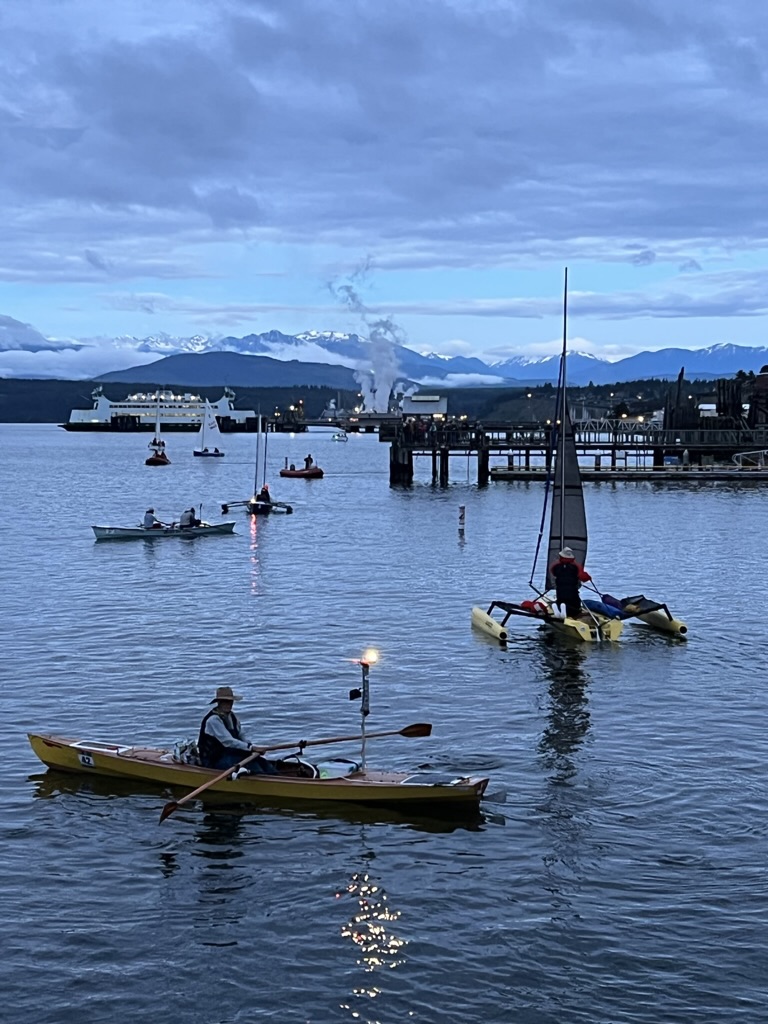
Back in the USA, we left PT at dawn a late August morning for an Orcas Island weekend.

Gulf Islands Victory Lap and Return to Port Townsend

 July 24 Woke up from a desperately needed sleep to voices in many languages on the Victoria waterfront.  Cleaned up the boat a bit, threw together a tuna salad from leftovers and provisions, and managed to get the laundry done just as Selena arrived with Amanda and Jeff. Everyone was in a celebratory mood. The advent of uncompromisingsummer sun had coincided with the weekend. Selena had just filed a big case against the State of California and was taking a break. We were resting on our laurels.

Over lunch we asked Selena if she wanted to do the Olympics or the Gulf Islands. She opted to stay in Canada and she and Amanda took off to get groceries, which are fairly distant from Victoria docks.

Once we knew we’d be in Victoria on Friday we called Erica and invited her for Sunday or Friday. Since Skander was there with 11 year old Evaan and 3-year old Nora, we decided to hang out on the boat and called Mona and Nelson to join us. The food Selena and Amanda brought from a nearby take out was delicious, though there was a misunderstanding over who wanted fish and chips (ie halibut and wedge fries) and who didn’t care. Swept up in the sudden return to civilization and its temptations, I made a bit of a fuss and ended up eating Erica’s halibut.

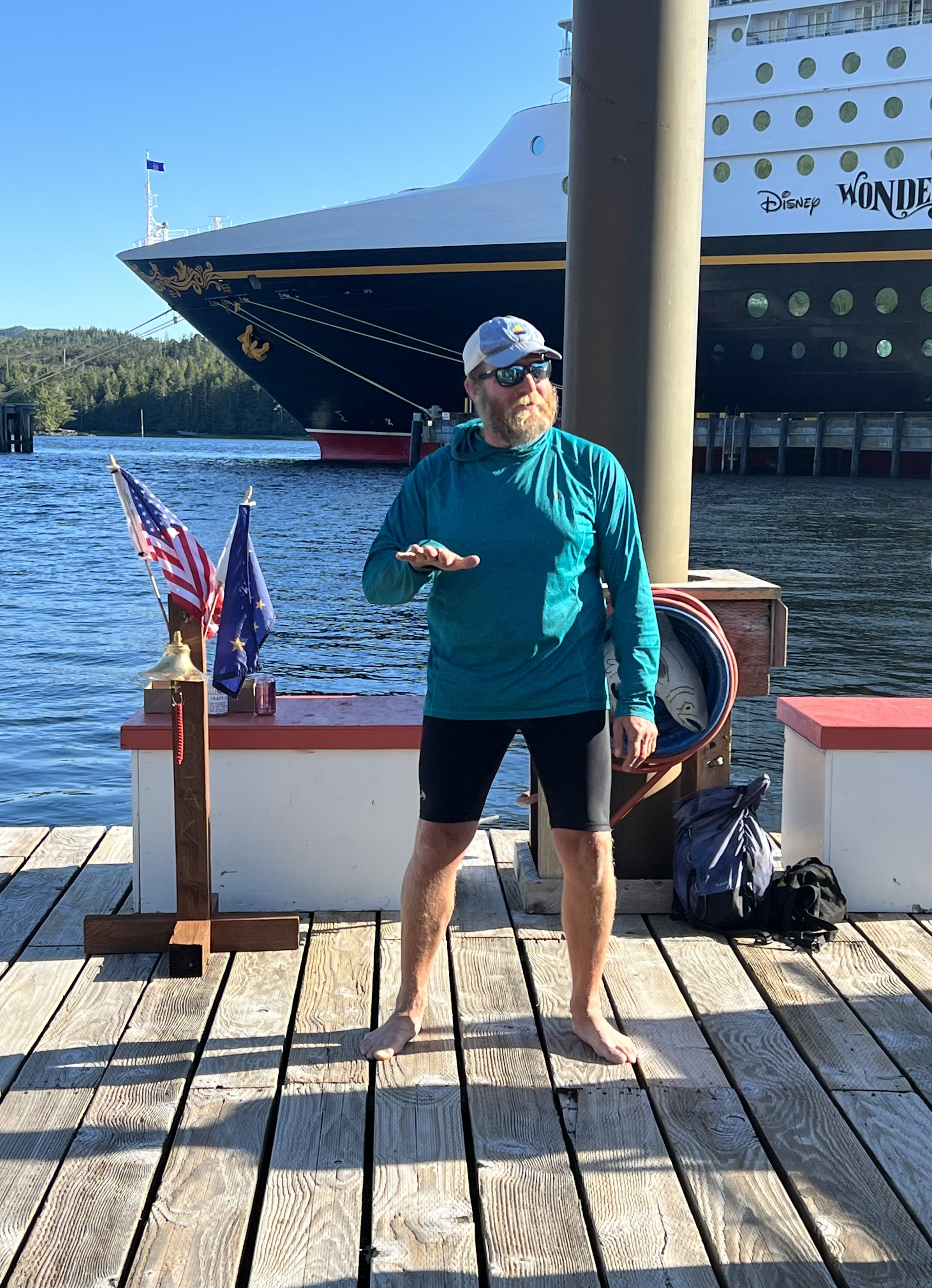
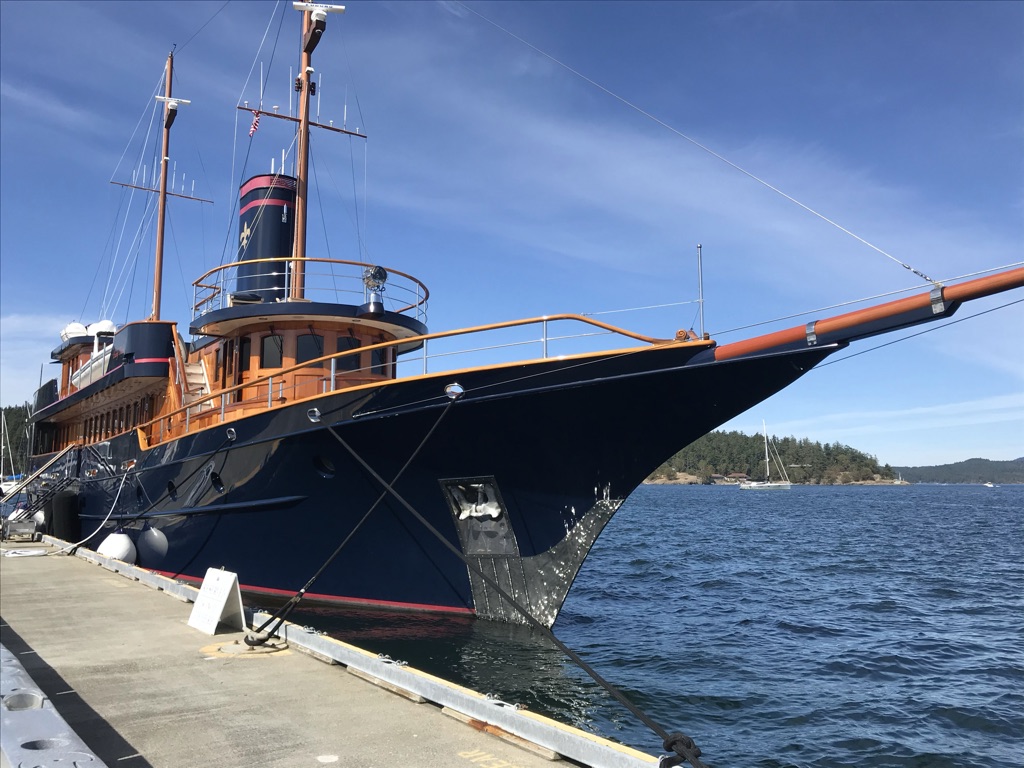
The cockpit was rather crowded and our view of the bay was blocked by the Attessa IV a 330 foot plus luxury yacht of unknown ownership being polished and provisioned by a uniformed crew. But the sun was heavenly and we a nice view of the waterfront and all the people gawking at the big boat and having their picture taken in front of it. Of course, Erica, who always lavishes us with hospitality, insisted that we all come for supper on Friday, exactly the trouble we’d been trying to save her.

July 25   Nothing is more dramatic than entering and exiting Victoria Harbour. First we had to get out of the dock; that went flawlessly and Jack backed out leaving unscathed the two historic live aboard ships near which we’d portside tied. We just missed the Coho, the car ferry from Port Angeles, which actually backs halfway out of the harbor without even a small tug assisting. Selena took the helm as a float plane landed parallel, a water taxis crossed in front and boats pulled in and out of the fuel dock.

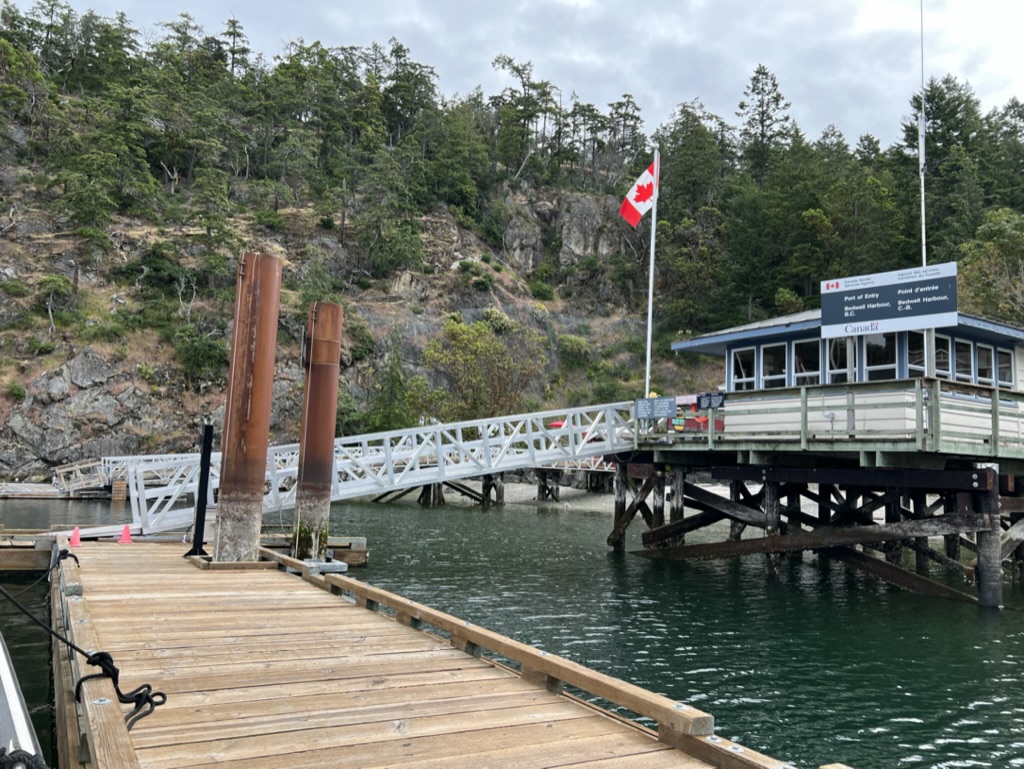
Confused and confusing waters rocked and rolled us as soon as we made it out but once we turned and got our sails into the wind it was a blast, at least until the ebb outpaced the wind in the boundary channel past Stuart, where we were unable to stop because we had not passed US customs. At Bedwell Harbor there was a single buoy, one near the cliff, which we nabbed in a single stroke. Selena was impressed.

July 26   The last time we’d stuck our nose into Ganges Harbour, it was so busy and so churned that we turned around and dropped anchor in the lovely west-facing Annette Inlet on Prevost Island. So this time we were determined to at last see one of the regions coolest little towns and Salt Spring Island. While we were dodging the crab pots, a suddenly fouled depth sounder showed 5.5 feet under our keel. Unnerving but wrong. We followed the chart, radioed the marina and came in comfortably on an end dock. The number of empty slips on this beautiful mid summer day confirmed the light number of cruisers this summer. This year sailboats reign. And differences in gas prices, the values of the dollars, and the cost of moorage make it advantageous for Canadians to head to the San Juans and Puget Sound this year.

Our arrival coincided with the weekly farmers market, small but exceptionally interesting despite the retarded season. We filled our bag and Selena did up several dishes of fresh veggies.

July 27  Selena and I wanted to hike but the trailhead eluded us and when we finlly found a little travelled road, we took it and found a delightful vineyard with a attesting room and a picnic table for lunch. The reliance of Salt Spring Islanders on their cars and their indifference to sidewalks made the otherwise lovely place feel like any other rural suburb anywhere.

The high point of Ganges was the circus on a sailboat. Well, that’s how it translates into the vernacular. La Loupiout  is from France, home to a young family. The parents are comédiens-danseurs-acrobats-funambules-mimes. They’ve created two completely different spectacles, one at 5:30 and another at 7:30. More when I get the pictures.  Delighted to see that they are coming to Port Townsend on August 20-22!

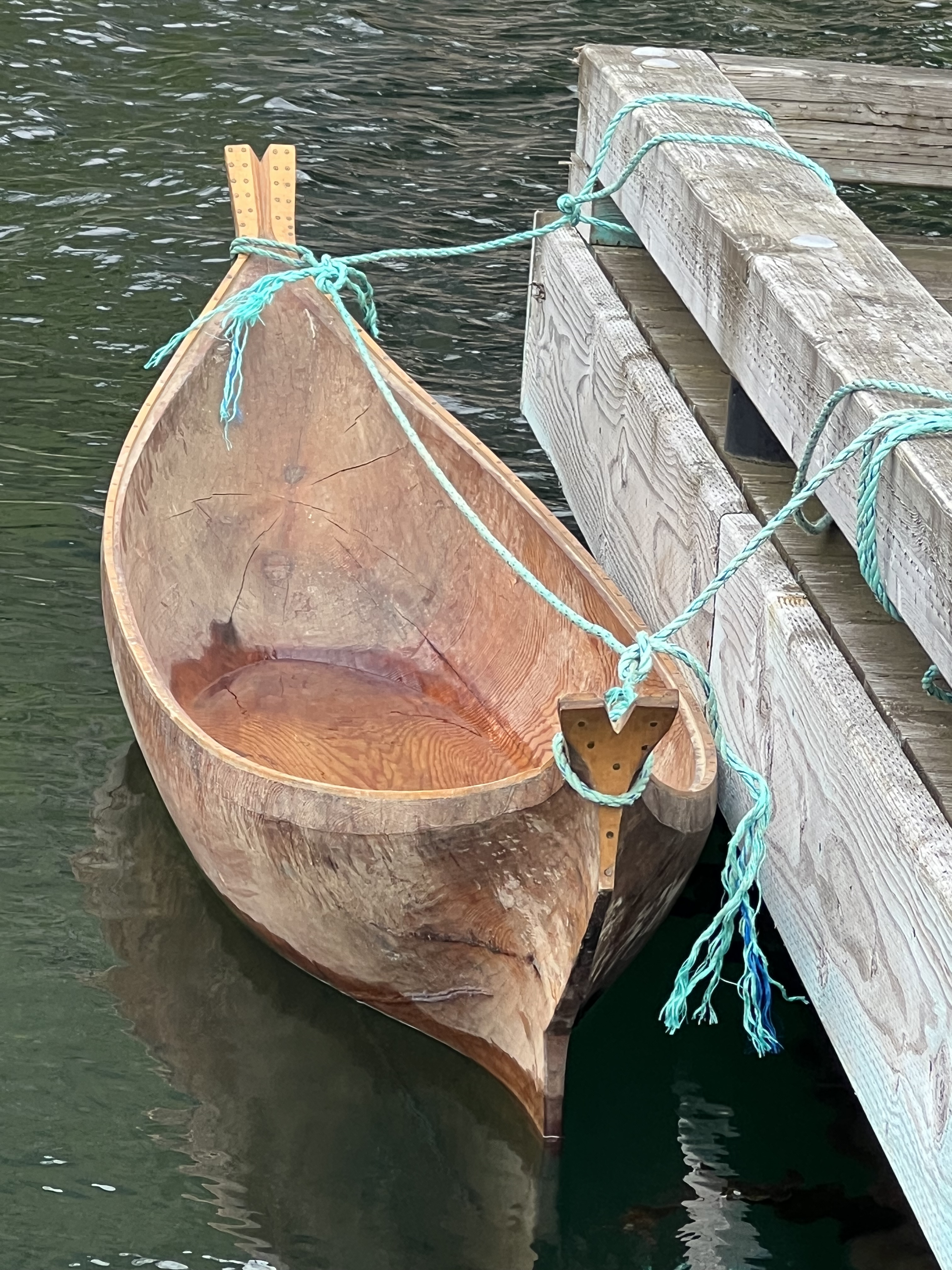
July 28 We departed Ganges at a little after 6 for a dreamy ride though the islands in the early morning sun. Selena appeared just as we turned in toward Victoria. We got an end tie near the entrance (opposite what they call Mary Tod Island Park) and watched the boats come and goIn the afternoon, Jack and I made our regular visit to the Maritime Museum, marveling over the Tillicum, the cedar canoe in which Voss cruised to far parts of the earth at the turn of the last century.

July 29 Morning reading on the boat. Afternoon at the museum. Supper at Erica’s. Frances missed her ferry from Vancouver and arrived late so we stayed late. Said good bye to Selena whom Mona dropped at Amanada’s so she could fly home the next day.

July 30 We left Oak Bay early but found good wind once we took the waves on our quarter sailing way out to the south east before jibing toward Cattle Pass. At Friday Harbor a young customs official found we had “prohibited items” and boarded with me to remove three perfectly ripened tomatoes, one kiwi and an anonymous apple. They found my passport funny – clumsy consular officer in Casablanca used white out! – and the infraction went on the record.

Next we went to the fuel dock and survived a remarkable jam of boats at the fuel dock, whale watchers and the Victoria Clipper arriving just as the car ferry was departing. Friday Harbor beautifully chaotic but it all seems to work out.

July 31. Best sail of the trip and most interesting destination. Home port of Port Townsend. A single tack took us from Cattle Pass to Hudson Point. All we did was adjust a couple of degrees and the amount of sail. A fitting finale to a great cruise.

Daily Log – from Barkley Sound to Victoria Harbour

Please note the pictures here don’t go with the text.  Just some of the endearing sights of British Columbia.

World food under one roof in Ucluelet

July 19    Known as the Broken Group, the islands at the mouth of Barkley Sound look like crumbs someone spilled on the chart – a mess of rocks, reefs, tiny islets with five trees and larger islands with pocket coves big enough for a fishing boat and beaches used by kayakers. Sailboats head through Clarke Benson passage for Effingham Bay, which offers good protection and ground and a trail that leads to former native settlements. Barkley Sound has been heavily inhabited since early times. The long narrow Alberni Inlet leads to the largest and easternmost of the West Coast cities – Port Alberni. We didn’t go there because it sounds like a winter car trip. Does the place really get 300 inches of rain a year as one of our books suggests? Need to check.

July 20   Lazy day working through the books we bought at Mermaid Tales Books in Tofino while nursing my back. I read Terry Galvin’s The Last Great Sea: A Voyage through the Human History of the North Pacific Ocean. A sweeping narrative meticulously documented.

Moving house means literally moving house.

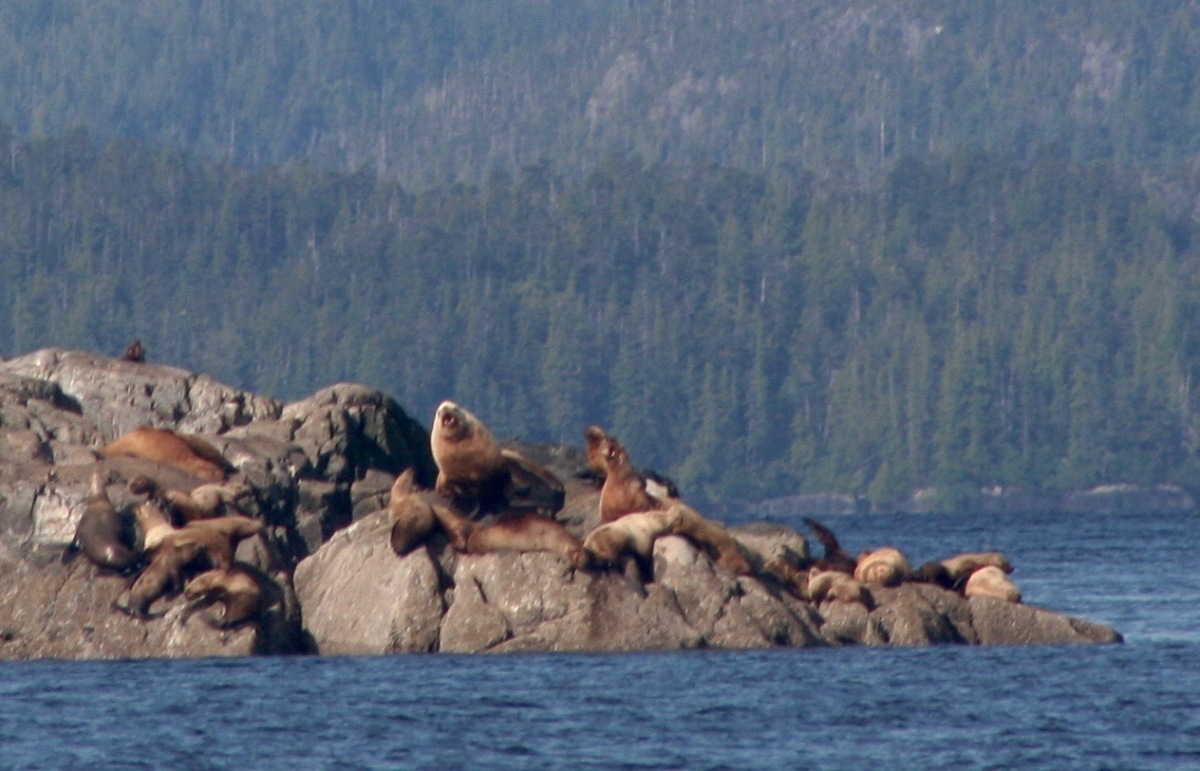
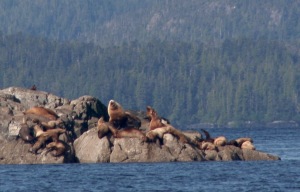
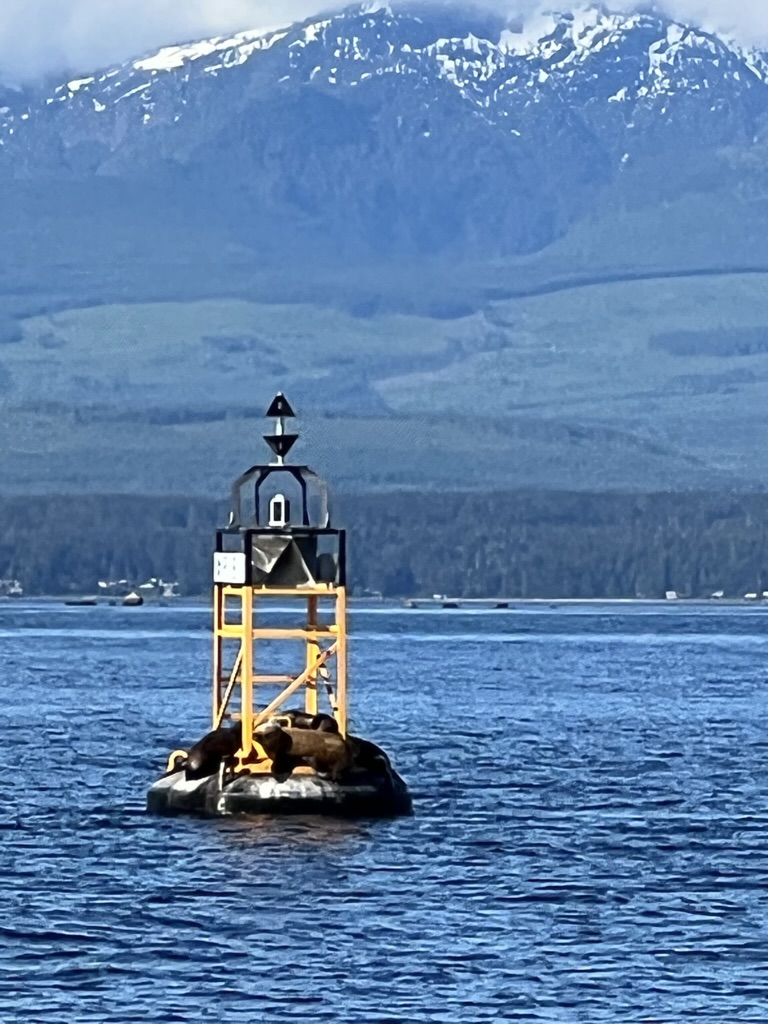
July 21  Reading a great book about the North Pacific rather than trying to explore its 25,000 miles of squiggled and jagged coastline makes sense. Refreshed with a new sense of understanding of our surroundings, we pull out of Effingham Bay and head west uneventfully past a lazy haul out of sea lions. We pull into the pretty, interesting village of Bamfield, whose main street is the Inlet. There’s a water taxi to cross the 250 residents from east to west, where’s there’s a marine sciences research facility run by a university consortium. I’m not sure what months of the year Bamfield is reachable by the forest road from Port Alberni but passengers and supplies are delivered a couple of time a week by the old steel hulled the Frances Barkley.

We tie up at the public dock where we’re greeted by Harbourmaster Sheryl, who fills us in on the place. It’s a wonderful dock with every conceivable kind of boat, all snuggled up no more than two feet between us. This proximity creates community as early arrivals catch thrown docking lines and tie up the later arrivals. There’s no pub on the west side so folks gather on the docks, having already broken out their eight-packs on the boardwalk in front of the general store. Supper is fresh prawns from the boat next to us, seasoned with some First Nation’s smokey salt from the boat across.

July 22  With an alert eye for the ardent pre-dawn sports fishermen who don’t light their boats, get and early start. is the north end of the West Coast Trail, built just over a hundred years ago to rescue shipwrecked sailors. Today it’s maintained for hikers, five of which start at each end. We’re on our way to the other end, Port San Juan. Seven hours of georgeous coastline later we pull into the small inlet which is humming with trailerable boats from Victoria. Our cursing books have not really prepared us for the lack of good anchorage but we put down the hook not far from the public dock, which has no floats and is busy with large fishing boats. The open ocean lies to one side and we rock and roll but we hold. We’re joined by a cruising sailboat, Xi from Bellingham, and they hold, too.

July 23  After I bring up 200 feet of chain, the anchor appears with a foot of seaweed on it and won’t slip back in the cradle. I start to pick off the many layers of long, wide fronds but they break. So I go down and get the breadknife and in 30 seconds have sawed everything off in a couple of great chunks. The sun is breaking hard over the low hills to our east so that by the time we reach open water the bay is bathed in light and color and the beach campers are up and off fishing in their little outboards.

Unfortunately, the pretty pink and blue patches of fog close in and turn to solid grey within as soon as we’re out into the west end of the Strait of Juan de Fuca. For the next seven hours we experience the worst fog we’ve ever been in. Fog is generally a temporary, morning thing that you just tough out until it burns off. So this hope nourished our passage even though the fog did not give us a glimpse of blue even overhead until we were off Race Rocks heading into Victoria! Ninety percent of the time we had one to five boat lengths of visibility. We were headed southeast straight into the sun which further compromised visibility beyond the bow.

So this was the second or third most challenging day of our trip. The good news was that we were in the best possible place: the clean, deep, regular northeast shore of the Strait far from the shipping lanes which carry the largest ships in the world. The bad news was the tiny ships. We could do real damage to an 18 foot aluminum fishing boat. And we’d seen dozens of them leave Port San Juan before 6 am, driven by the splendid warmth of the day and the lack of wind.

Herons where you expect bald eagles.

So we spent the day like this. We put up the mainsail so we could be better seen. We slowed to just a couple of knots. Jack stayed at the helm so we could act quickly if necessary. I spent most of my time right in the prow where I could hear and see better but had to make occasional sprints to the cockpit to check the radar at the top of the companionway, where the screen is more easily read out of bright light.

Every minute or two I blew the fog horn. The Xi was slightly ahead of us and responded reassuringly for nearly the first hour. After getting dizzy blowing the metal cone, I moved to compressed air and used up the first bottle in a couple of hours. We’d remembered that one long and two short blasts were for a boat under sail and not able to recollect more than that used that signal. Now if I’d been sitting at my desk in Portland and heard a fog horn blast out on the Willamette, it would have taken me less than a minute to google up “fog horn signals” and identify it. But out here we are left to our under-exercised memories. Lesson learned: load the boat with intelligently organized binders of paper instructions and the computer with useful pfds, and every year re-read basics like the Rules of the Road and Nigel Calder’s How to Read a Nautical Chart. Being surrounded by instant how to information ultimately de-skills sailors. We need to constantly be ready and be hands on with all concentration on the task.

The trouble with fog horns is that fishing families with trailerable boats don’t carry them. So my ears had to be really good. In our only really close encounter, I suddenly heard a whistle and voila on our port beam, not two boat lengths away were two guys standing in a little aluminum skiff. I asked them how the fishing was, they said great. Whew!

Of course we had not taken the precaution of having breakfast so by lunch time I made a mad dash to the galley for bread, cheese, sausage, knife and cutting board and constructed our sandwiches in the bow. From time to time we’d see a brighter circular disk and thought the sun might be dispelling the fog but again and again it just closed in again. It was getting hot. We’d never expected the fog to stay with us until Sooke, a sizable town 15 miles from Victoria, but it did. Since the harbor is tricky to enter we knew we’d be better off just going on. But since a Saturday morning in July, the first warm one in nearly a year, was likely to draw everyone and his brother out fishing, we moved further off shore. But of course without the usual hazards of wind and swell, so did they. Off Sooke we saw a ghostly dark shadow pass in front of us and several small white apparitions off to the sides. We have no idea whether or not they saw us.

One we got out of range of Sooke’s boats and not yet in the range of Victoria shipping, the blue sky started to show overhead and then the bright green hills of Vancouver Island. And then the blue of the Strait. And finally, above the clouds, the snow-capped peaks of the Olympics. And within a half an hour everything was perfectly clear.

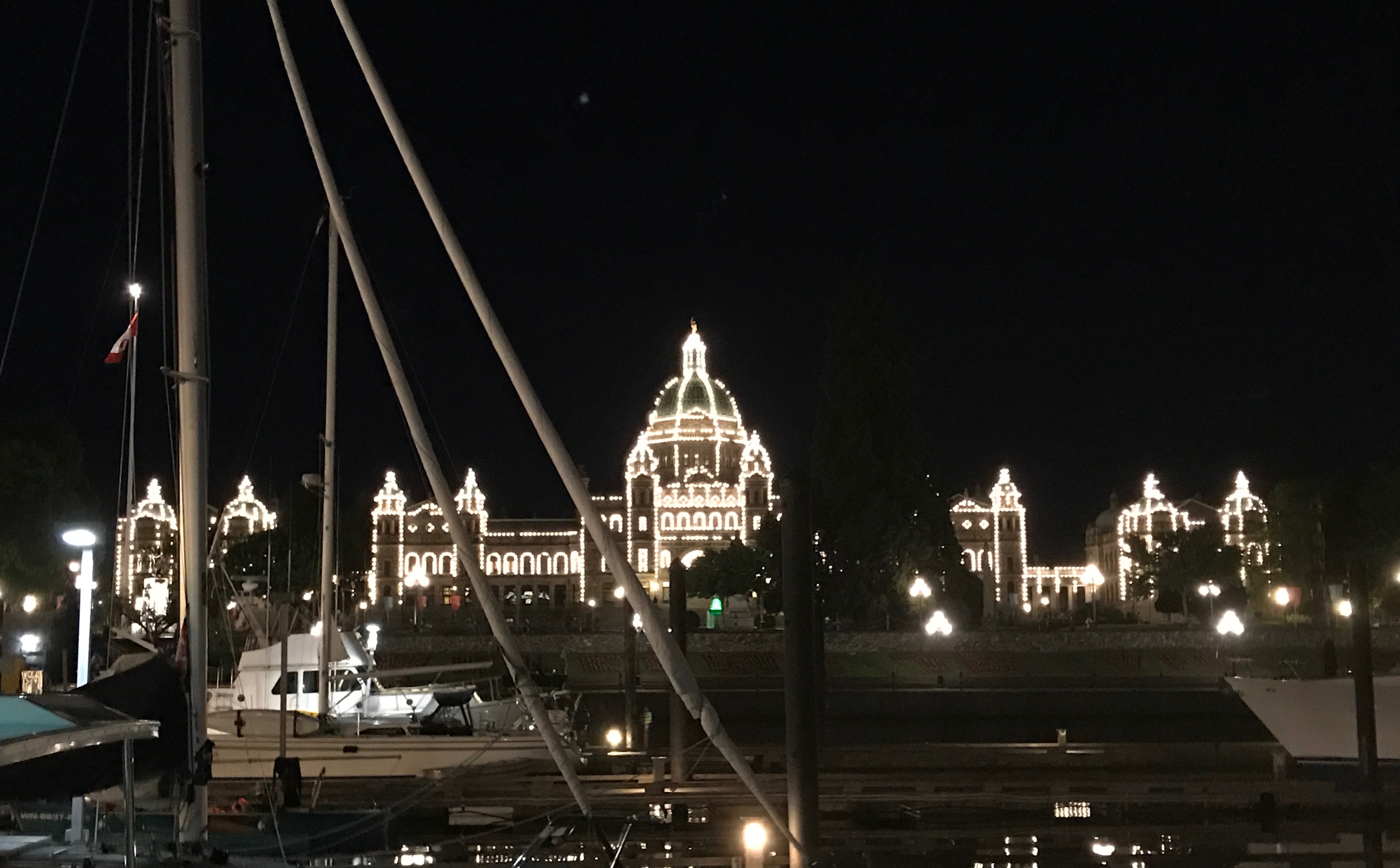
We radioed Victoria Harbour and went on in past the fishing port, float planes and large ships coming and going in the lane immediately adjacent to ours, little puts taxis crossing our paths. We motored past Parliament and the Empress Hotel to the float the slip of our dreams. We tied up right next to Wharf Street at the foot of Bastion Square, on the edge of Victoria’s Old Town, with Chinatown just beyond. As the thousands of people wandering along the waterfront, listening to buskers, jamming the caddis and pubs, lounging on the Empress’ vast lawn (making it look like Woodstock) would all agree, summer had finally – FINALLY – started!

Daily Sailing Log – July 2 – 18

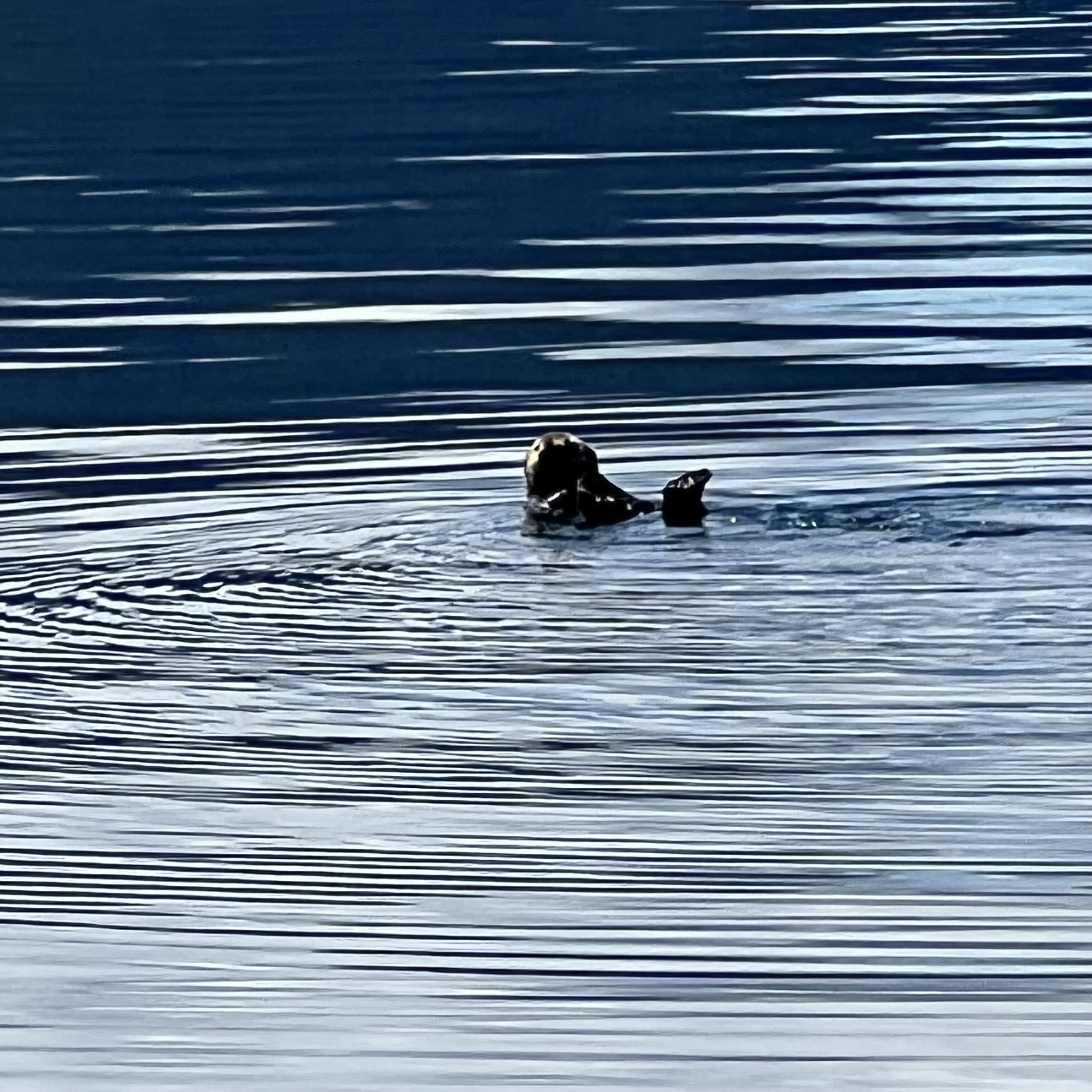
Sea otter applauds as we pass by

July 2  It’s still drizzling when we wound our way out of the narrow passage between the island with the Walter’s Cove public wharf and the mainland with the village of Kuyquot. Good visibility helped us dodge the rocky islets on the way to the main entrance of the spectacular and isolated Kyuquot Sound. We has just left Rugged Point on starboard when our engine alarm went off signaling overheating. It was a good sign that there was water coming out with the exhaust. We made a u-turn and anchored in a little cove off Rugged Point and set about checking for the problem. Since our engine is new and this had never happened before, we opened up Nigel Calder’s Diesel Engine Maintenance and Repair and worked our way though the checklist. After closing the through-hull we cleared a bit of seaweed out of the raw water strainer but found nothing like a jellyfish or the tenicle of one of those horrible twenty-legged starfish that kept getting stuck on the Walters Cove dock pilings at low tide. Next thing was to take off the raw water intake hose. The hose clamps were rusty and I managed to split the hose while taking if off. Then we cut up a plastic coat hanger leaving a small hook at either end and pushed it down the hose from the strainer and into the open through hull. To make sure there really was no obstruction we took the lead line from our [yet unused] crab pot and pushed about four feet of it out through the hull. Water now fountained up freely. So we dried everything off, unrusted the clamps with WD-40, duct taped the hose, put everything back together,reopened the value on the through hull, pulled up the anchor and set out again into Kyuquot Channel.

No more than 15 minutes later, the engine overheated again so we did another u-turn to Rugged Point and dropped anchor. While a bit discouraged at the prospect of spending more time in the engine room rocked by incoming swells, it was better than being in the open ocean. The next thing on Nigel’s [and everyone else's] checklist is an impeller change, something we’d not yet done on the new engine. Sure enough the old one had feet going in different directions so with considerable effort, I removed it, and with considerable speed managed to slip in the new one. I take it back: none of this was done with speed. I moved very slowly, thanks to my Dramamine and sunset that would not fall until nearly 10 pm. In engine repairs, speed hurts; consider the trouble of using chopsticks to fish a dropped washer or nut out from unfit the engine or the longer term consequences of a bloody finger. Finally we motored up Kyuquot Inlet, now a thousand shades of grey, and about 45 minutes later turned into our anchorage. Dixie Cove on Hohoae Island consists of two small basins surrounded by old growth forest. A sea otter languishing on his back over supper in the second narrow isthmus stared at us as we passed and dropped the hook in the most magical, clam, secluded inlet we’ve ever experienced. Hungry as horses, we devoured a pasta supper and slept like logs on our laurels.

July 3  Finally a beautiful day. Coffee on deck talking to the sea otter and listening to stereophonic flow of fresh water springs on either side. At low tide the walls of the cove – orange (mussels), bright green (algae) and grey (granite) – became a kaleidoscope of phantasmic monsters reflected on the mirror of the waters. We have never never seen such a fabulous anchorage. We yearned to stay but a weather window was pushing us on to the next open water passage.

No sooner had we entered Clear Passage between the rocky barrier islands and Van Isle than the overheating alarm went off again, making a mockery of all of our valiant efforts. We had no choice but to turn off the engine and drift, which worked very well because it was extremely calm. So that’s how we got through the passage a bit of engine – a bit of drift. The coast was absolutely beautiful and it was wonderful to just sit there with nothing to do. Soon we’d be in the open ocean and as the wind had promised to pick up in the late morning, we could sail.

But the wind never came. It was the doldrums. We drifted. We enjoyed the sun and the view. We brought all of the last three days of wet clothes up on deck. After a long and pleasant day, a bit of wind brought us through the buoys marking Esperanza Inlet, past some Canada Day weekend sports fishermen and sea kayakers, and we sailed on into Queen’s Cove at the beginning of Port Eliza Inlet, which is an inlet not a port with any place to moor except where we were.

July 4.   A good night’s sleep and a day off. We sleep, we read, we do not worry about our engine not working. We are off Nootka Island, the second largest island on the BC coast, which snugs into Vancouver Island, the largest (on both the BC coast and all of North America.) Deep fiords around the island connect Nootka Sound, with the villages of Zeballos, from where a long gravel road leads to Port Hardy and Tahsis, connected to Campbell River by a shorter gravel road.

July 5.  Lift anchor. Motor out past reef into Port Eliza. The overheating alarm goes on. All within 5 minutes. We drift while Jack radios the Coast Guard. So efficient. They patch us ship to shore to the nearest marine services, inland up the fjords in Tahsis. Problem discussed. They will send a tow. Coast Guard and Westview Marine Services both remain on VHF while we enjoy big breakfast and good books. Finally small open – 19 foot – Pelican pulls into cove. Wade, missing front teeth, in orange survival suit, hands me 50 foot line. He doesn’t know knots but we figure out a bridle on cleats and tie his line on with a bowline. Off we go. He has no chat but…shows he knows. I join Jack in relaxation. After a good lunch, I read and take pictures, he stretches out in the cockpit. Up Esperanza, through narrows, up Tahsis, the clouds part, the sun comes out. I actually take off my sweater and am in a tee shirt. We get almost there. Jack coordinates on VHF with Wade and marina.

July 6   Cruising luxury: No real rain. First chance to do three weeks laundry. Internet: answer email and edit fact sheet for Sustainable Sanitation Alliance. Dinner on the dock grilled Salt Spring lamb. On CBC “Waktell on the Arts in the Summer” Robert LePage b. 1957 author of “Dragon Trilogy” about Canada’s Chinatowns allopicha malady where kids lose all their hair. Knows so much about China. When on NPR do we get an hour long interview that forces us to go to bed an hour later than planned?

July 7     Tahsis Inlet is long and beautiful. We put out the jenny and let the channel winds take us toward the ocean. On the way early morning anglers, the Uchuck III, sea otters, and clear cut lots filling up with second growth. We motor through the narrows, past a tug and log boom treading water. No other cruisers. As Tahsis broadens to Nootka, we put out the jenny and sail toward the Nooktka Light and Friendly Cove. This is the birthplace of British Columbia, if not of the entire Pacific Northwest. Captain Cook pulled in here to make repairs on Discovery in 1778, making contact with the Nuth Chah Nulth headed by chief, or Maquinna. In 1792, the great sea captains George Vancouver and Juan de Bodega Quadra met here, representing their countries in an eventually successful effort to stave off a world war. In 1803, as the fur trade picked up its pace, Captain Robert Stanley guided the Boston in the cove, inadvertently insulted Maquinna, and suffered the revenge of the Natives for a string of similar insults and indiscretions of white explorers and traders over the years. The entire crew of the Boston was massacred, their heads displayed on pols to be identified by the shop’s blacksmith, John Jewitt, who lived to tell the tale. And what a tale it is! The original 1815 edition of his Narrative, today issued as The While Slaves of Maquinna, is a page turner, a movie in print, a thoroughly engaging recitation of cultural context and historical fact.

The wind is blowing hard when we enter the small, exposed cove and pull up at the empty public wharf tucked behind the lighthouse and Coast Guard Station. As I am tying up in the wind, quad comes down the dock to meet us. It is Ray Williams, of the only remaining Mowachat family living in Yuquot, the village of Friendly Cove. He greets us warmly and invites us to come ashore, permission which is necessary to visit any Native land. His son Sanford, a noted woodcarver with a current exhibit at a gallery in Tofino, is at work in his studio on the beach. I say I’ll be up after lunch as Mr. Williams bids us farewell with “cho,” goodbye in his language.

Fatigue takes over and I fall into a deep slumber after lunch and sleep off the afternoon. By the time I get to shore, there’s a closed sign on the trail to Sanford’s shop so I do a quick tour of the rest to ensure it is accessible by scooter – and go get Jack. Behind the two-story house of Williams on the cove is a meadowed hill with a church, built in 1957 as a conventional Catholic sanctuary, later fitted out with totem poles. On the edge of the forest is Yacout’s burial grounds, a mix of granite crosses and totem poles. From the the bluff is the open Pacific from which we could see Estaban Point, our challenge for the morning.

Sailing from Nootka Sound around Estaban Point

July 8  Dressed and ready to go, Jack lets me sleep in until 5:30. The day is calm and clear despite Environment Canada’s prediction of 15 to 20 knot winds. As soon as I am awake – no coffee, one single Dramamime tablet – I untie all the lines and we’re off. Sports fishing boat from all over the vast Nootka Sound are already bobbing on the swells around Friendly Cove light as we head straight west into the Pacific. The Perouse shoals lie off Estaban point and even though we are off them, we are rolled buy swells off the portside stern. We tie ourselves into the cockpit and I take the helm to settle my stomach. Eventually Jack puts on the autohelm and I sit on the edge of the cockpit. The horizon is lumpy and I think I am seeing low-lying shoals so I watch carefully as they flatten. ‘The World is Flat! The World is Flat!” is my mantra, as I tell myself we will get to the edge. It works, even as we turn south and the swells give us a good rocking. On port, we leave the tall, shoal founded Estaban Light, the only place in all of Canada to come under attack during World War II, when the Japanese took a couple of shots of it.

The morning is beautiful. After passing the mouth of Hesquiat Harbour, we sail the jib until we reach Hot Springs Cove.

July 9    Forty years down. Going for fifty. Today is our fortieth wedding anniversary. Forty years ago we had just been married by the Khalifa of the Pasha of Marrakesh and an Andalusian orchestra was playing in the Hotel de Ville for all the King’s men gathered there. The next day we found ourselves in the brief-lived Republic of Morocco, a group of renegade generals having overthrown the King as he celebrated his fifty-sixth birthday, a move that would have been successful had the wily King not persuaded those tasked with finishing him off not to do it. The next two generations of Moroccan school children would not hear of the Skihirat (pronounced Ce qui rate) coup d’etat which made the story of our wedding much more fun to tell when we returned to live in the Kingdom many years later.

When we made it to thirty years – by then also seeing a future following Jack’s accident – we had another Marrakesh celebration. A hundred friends and family, including three of our parents who been at the original weeklong event, made their way back to mid-summer Marrakesh for a week of festivities. We are not prone to throwing parties but this really capped the three decades and left us thankful for the people who have made our lives so rich and those parents who raised us and would all pass away in the intervening decade, in their nineties.

We had every intention of having a big Waterfront Blues bash in Portland for the 40th but once we learned to sail, July 9 fell in the middle of cruising season and since no one showed up despite our invitations, our celebration was modest. On his way out to sea, a Native fisherman from the village in Hot Springs Cove checked his pots and delivered two enormous and very active Dungeness crabs to the public dock where we are tied up. Enjoying the drama of getting them into the pot – one at a time as they were too big – and the mess of hammering away with garlic buttered fingers, we devoured one for lunch and from the second saved more than a pound of flesh. Once we get somewhere where we can buy eggs, we’ll break it out of the freezer for crab cakes. Dinner was roast chicken with a fine Bordeaux Pierre had left in the bilge during our April cruise.

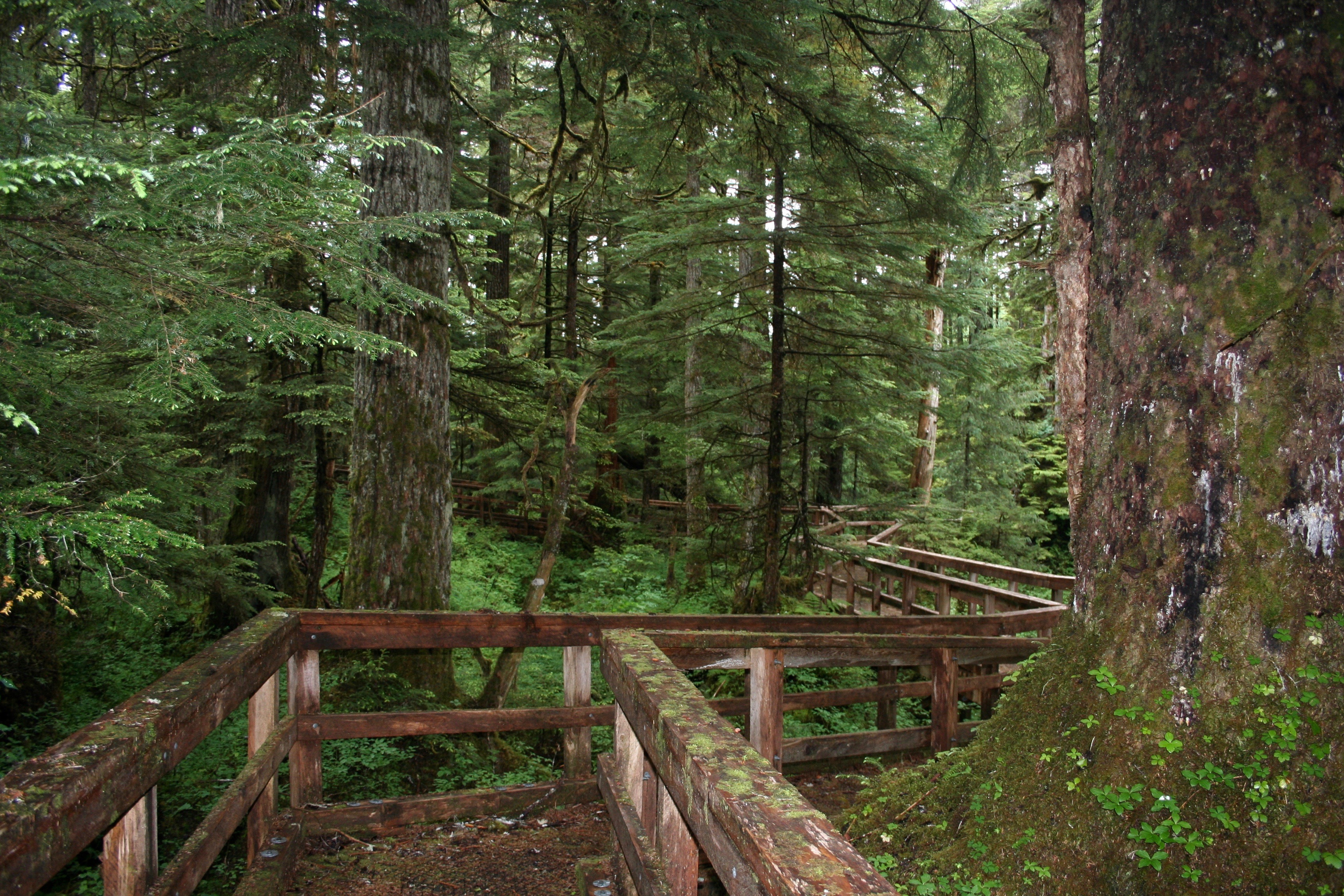
“Hot Springs Cove is one of the reasons cruising boats do the West Coast”, writes Bob Hale. “The challenge of getting to Hot Springs is sufficient to make the reward – a soothing bath in comforting water – worth the entire trip.” Indeed, cruisers have replaced planks in the boardwalk leading to the springs with intricately carved and illustrated planks bearing the names of their ships and the year of their cruise. Since we love BC’s coastal boardwalks – Hartley Bay’s is the best followed closely by Winter Harbour’s – we were disappointed to find that the the Hot Springs boardwalk has 803 up and down steps. So Jack missed his bath and I shared mine with a bunch of other people, some of whom had cheated and come up from Tofino by speedboat and floatplane. The quiet walk through two kilometers of old growth forest, under and over ancient nurse logs, was spectacular. When we get home to Port Townsend, we’ll go to Olympic National Park, where thanks to the ADA, ancient rainforest boardwalks are ramped.

July 10  Finally it feels like summer. Before the warmth can bring in mid-morning fog the way it did yesterday, we are around Sharpe Point and on our way up Sidney Inlet. Grace follows us for a distance; we are amazed that her crew is not taking a rest day after bringing their tiny ship so far through open waters. Sea Otters float past; we slow to admire one fellow on port and realize that a whole ragged raft of a dozen of them has floated past on starboard. I vow to never leave my advance warning wild life alert station at the mast, breakfast or no breakfast. We turn east into Shelter Inlet and take it to the very end. We pass though a narrow inlet and into an enclosed bay where snow capped peaks rise out of the virgin forest. Grassy headed Bacchante Bay reminds me one where we stopped on our way to Alaska and gives me hope that we’ll finally see bears. We anchor a bit too close to the shoal on the first try but on the next drop the sun comes hard out and Aurora remains motionless for the next 20 hours, her anchor chain and snubber both relaxed.

As are her crew. Apart from the distant sounds of a floatplane passing, there is no sign of civilization. We spend the day on deck in the sun reading. I finish John Jewitt’s narrative and pass it on to Jack who relinquished his Kindle, providing the ideal occasion for me to read Paul’s stories. What a wonderful book! Paul Rippey’s Cow of Gowdougou is to Guinea-Conakry what Jane Kramer’s Honor to the Bride is to Morocco. A rollicking, culturally astute literary penetration of the absurdities of another culture. I am in awe of people we can write this way, zeroing in on situations that are too crazy to be true but are. Now that I think about it, I hated Honor to the Bride when I first read it. It came out about the time of our own Moroccan wedding. This was Jack’s fairly sound idea for an event which soon moved completely out of our hands-intentions-responsibilities and into those of others. Jack’s friends not only filled the house with livestock and lined up all the necessary sorts of musicians, but stopped an innocent girl walking past a tailor’s shop and had her measured for a royal purple velours wedding kaftan – a surprise gift – because she looked to be about my size. It got more complicated when my friends arrived from the popular quarters of Casablanca and Beni Mellal. Women live for weddings. Amazing how complex a simple event like a trip to the public baths can get when it’s part of a wedding. No wonder celebrations can never last less than a week. Although no cultural stone went unturned, we survived and even enjoyed ourselves. But then to have Jane Kramer make jokes about a typical Moroccan wedding offended me. Eventually, my dour long-suffering hairy shirt Peace Corps disposition wore off. Today I love Honor to the Bride and Paul’s Cow is right up there with it.

July 11   We reluctantly pulled up anchor in Bacchante Cove under a brief rainstorm that was over by the time we got out into Shelter Inlet. We spotted two sailboats giants the short of the well-named Obstruction Island, which sits right where Millar Inlet meets Shelter. They turned out to be First Light and Reality so we waved to the folks from Port Ludlow we’d met in Port Hardy. Nothing was easier than getting through Hayden Passage at slack and around Obstruction Island and out into broad Millar Inlet. Unfortunately this part of Clayquot Sound has both struggling second growth and fish farms. But we delighted in the sea otters and spent half an hour watching a humpback crisscrossing the channel in front of us.

Finally we pulled into the narrow Mathilda Inlet and pulled up to the dock in front of the Ahousat General Store, which Bob Hale calls a “rough-and-ready place” It was a bit of a challenge to tie up on the rusty cleats home forged out of pipes and Jack found owner Hugh Clarke a bit grumpy when we purchased some fuel. So when I went up the ramp to pay and to pick up some eggs, I took the opportunity to sit in the empty plastic chair opposite the cash register and chat with Hugh and his sister. Their parents had given the 35 acre Hot Springs property to the Province to use as parkland. We talked about the long winter, the slow start to the season, and our nations’ respective party politics. The sister’s question “Which party is the nigger’s?” confirmed the backwoods hillbilly character of the place, magnified in my mind all afternoon by Annie Proux’s Heart Songs. These vivid and desolate stories of the last rural blue-collar folks in New England towns whose old houses become second homes of city folk resonate strongly here on the BC Coast. The difference is that city folks are not buying up properties. Oh sure, there are odd fishing outposts, be it a modest camps or an isolated fly in lodge. But there’s no run on land here. In fact, up and down the coast there are people like the Clarkes who have had their properties up for sale for years.

To be fair to Ahousat, the store is really a general store and the phone in the booth out front works. One hundred and fifty residents of the nearby Native settlement of Marktosis have postal boxes at the store. Nothing is more vital to a community with lots of small fishing boats and float planes than a fuel dock. In the evening, Native families stopped by; one with three little kids paddled up in an Old Town canoe and everyone had an ice cream. At sunset a couple of fishermen pulled up in a tiny boat and laid out an impressive haul of chinook, halibut, and white and green (yes!) ling cod. Hugh and a pretty young U Vic graduate student studying grey whales came down on the docks to chat while the the fishermen cleaned, filleted and zip locked their catch, before taking a room above the store.

July 12   West Whitepine Cove It’s discouraging to pass so many fish farms, the last one anchored way out in our path. But we snuggle into West Whitepine Cove at the foot of Catface Mountain. Inner cove looks better for watching bears but it’s risky with less than a fathom at low tide. I sit on the deck in the sun finally reading back issues of Pacitic Yachting. A letter to the editor from Friends of Clayquot Sound noting that the BC government has renewed the exploration permit of multinational mining company looking for copper and other metals on Catface Mountain and gearing for the fight should they apply for a permit to actually mine, and likely take off the top of Catface. Yikes. Clayquout is spectacularly beautiful. Perhaps twice the size of Puget Sound it has far less than a hundredth of a percent of its population. We need to get to Tofino and find out what’s being done to push back against clearcutting, fish farms and mining.

I’m astounded to see a large sailboat emerge from the inner cove. In Tofino we learn they have a pull-up centerboard and yes there were bears.

July 13  Getting into Tofino is hell. This is the place the Spanish should have name Sucia – dirty. Everywhere shoal, rocks, sandbars, crazy currents and crab pots. Red buoys are unnervingly to our left; I guess this is because we’re coming from the northern part of Clayquot Sound. How did this place even become a port in the first place?
The waterfront is impossibly busy: speedy fishing boats, a tug with tow, float planes landing and taking off, trollers, gillnetters, strangely rigged clamming and crabbing boats, big inflattables with tourists in red survival suits. We call the Harbour Master and get no reply until we are in port, or rather in the channel immediately next to it though which much of this traffic pass. At one point, Jack confesses later, we’re in a mere 8 feet of water (and we draw 6). But suddenly out of nowhere, the Harbour Master appears in an aluminum skiff with two huge dogs and escorts us toward a tiny space, jumps out of the skiff, introduces self and dogs, and grabs the bowline. No bad for one of the craziest ports I’ve ever laid eyes on: fishing boats rafted three abreast, a multideck cruiser tied up to a sailboat, crab traps and ice chests piled on docks, electrical cords and water hoses snaking around everywhere. Yep, Vince Payette knows his stuff – this chaos is managed with a remarkable degree of sophistication. And Vince is a world class talker and share interesting information. We learn oodles from him.

At Mermaid Tales Bookshop we pick up the freebies put out by the enviro groups and refresh our library with some good books after getting recommendations from the owners.

July 14   I awake at dawn to Mireille Mathieu’s rousing rendition of La Marseillaise coming though my Walkman headphones. Nice to have the radio after a week without any. Busy day. Laundry, boat cleaning, and provisioning because Terri, Tom and Midori are coming on board at midnight. Whew. But if our day was long, theirs was longer. They arrive at 1:30 pm cheerful and full of silly apologies for being tardy. I-5 and the “Tacoma Narrows”, customs, ferry to Nainaimo and Route 4 to Tofino, which unbelievably, has a caution sign announcing an 18% downhill grade. Yikes.

July 15   Everyone sleeps in because we are not even going to attempt the channel out of Tofino to the east until dead slack, which falls in the early afternoon. It’s raining. Hard. T and T have been trying to escape the rain all summer and have utterly failed. But we are all excited about Terri fishing and crabbing. They go off for net and bait.

Morning brings visits from Bob of Cool Change, which was moored near us last winter in Olympia, and Doug the DFO inspector whose working boat is rafted to his sailboat Vagabunda which is rafted to a geoduck clammer which is actually tied to the dock. We eat a hot breakfast and cook up a big pot of chili. Everyone and everything is wet; I scare up another $2.75 and dry out my clothes before our departure. By this time the women-crewed Voyager from Ladysmith, escaping from 50 knot winds on the outside, has tied half of its length to the bit of doc on our stern. Then a smaller sailboat rafts to it. By the time our departure time comes, it takes the crews of all three boats to get us out. Tofino is one of those places where helpful cooperation becomes a necessity.

Windy Cove where we drop anchor close to shore is granite walled on one side and old growth all around. It never stops raining. Terri’s out crab pot and pole and wonders if there’s something to cover the cockpit. Deep in the lazaretto we find the bikini and with the extra hands manage to get it up. Wow, what a difference. We sit out, watch the rain, pull up the pot to find lots of too small crabs.

July 16    Temperature up a bit so rain-with-cold has been replaced with rain-with-fog Leaving Windy Bay we get into some shallow water before the GPS can find its satellites. Here in Clayquot sound we’ve used the GPS on the iPad to actually navigate and need to remember to power it up before raising the anchor. Not the sort of thing you do in the deep waters with steeply descending coastlines on the Inside Passage. We continue around Meares Island to Quait Bay, a large place with a floating fishing lodge that is not in operation. Nor are we alone: Mytyme, the Nauticat ketch that come into Tahsis disabled is there as well. We put up the bikini against the rain and Terri sets to work. Just as we’re getting really hungry Terri pulls out of the trap two sizable males, one a Dungeness and one a Red Rock Crab. Thoroughly reenergized despite the constant downpour, she proceeds to teach us how to make Crab Head Soup. Stay tuned for recipe. The evening meal is an all-Crab fest in honor of Tom’s birthday. Terri brings in – literally no gloves – a huge Dungness for head soup and crabmeat while I thaw the crabmeat from Hot Springs Cove for crab cakes. Yum.

July 17  The rain finally gives up. After a leisurely morning we round Meares in semi sun, disappointed to not see the expected wildlife. We wrestle with shoal, springtide currents and crab pots in the channel and make our way back to Tofino. Jack and I prepare for our outside passage by turning in while Terri and Tom pack up their stuff for the long trip back, this time though Victoria and Port Angeles.

June 18  An absolutely splendid passage! Jack and I were both looking up for several great sightings. Shortly out of Tofino a grey whale launched himself entirely out of the water and landed with splash being enough to serious wake us had we been closer. Later another, a bit further off. The rocky coast interspersed with beaches makes great background for whales. All along shore we followed spouting, mostly humpbacks with one especially wonderful dive.

We stayed on LaPerouse Bank – it starts at Estaban Point – and had to get though forests of crab traps but the abundance of birds and mammals made up for it. The sun was bright by the time we turned into Ucluelet’s long inlet. Since we’ve been out nearly 45 days we needed to contact Canadian customs for a routine extention so we first pulled up at the customs dock. There I took a stupid, near calamitous fall which was a learning experience. Jack docked perfectly and I stepped off and secured the mid line with no difficulty. But when I put the sternline under the dock toe rail and started to put my full weight into it, the line caught briefly on the padeye on the boat toenail. So my efforts put me splat flat on my back across the dock where the base of my skull hit the chrome rail of a little outboard boat docked opposite and made me see stars. Just as I’m thinking, “Now, I’ve really gone and ruined this vacation”, a man rushed up, told me to stay put and tied up the boat. I wiggled to see that everything worked – it did but had I failed an inch more to the rear I could have broken my neck. The man looked relieved and as he turned to go I read Harbour Master on the back of his tee shirt. “Are you, Steve?”, I asked. Indeed it was Uclulet’s acclaimed Harbour Master Steve Bird. Jack asked about moorage in the small craft harbour and he went ahead to greet us there on dock D.

The Lesson Learned: After I’d tossed the bowline, Steve took the sternline out of my hand and said. “I don’t usually give guest guests docking advice but this may help. Put the line over the toe rail, not under it. This way you can stop the boat. It won’t tie the boat in the place you want it but it will stop the boat so you can decide what to do next.”

M/V Uchuck III

Uchuck III pulls in behind sailboats at Kyuquot dock

Somewhere in the midst of our well-deserved post-prandial naps, we sense movement around us. Voices, outboards, legs of people and dogs on the dock on high side of our low tide portholes. Finally when I  rouse myself, I find the renowned Uchuck towering over us and the other little sailing circumnavigators lashed to the dock flats. M/V Uchuck III is the once-a-week supply boat that has nourished these villages for generations.

What a cool boat! She must be about 100 feet long and is made of wood. Her powerfully built black prow stands nearly 25 feet above the waterline. She’s got every manner of cranes and winches that can take stuff to into and out of her massive hold. There’s large spar from the base of which two great pole extend obliquely, giving her the look of an overgrown troller.

Floks arrive to pick up their supplies.

With the help of the operator standing on the bow, the cranes sway and lift cargo our of her gaping hold while workers down below call out instructions. Freezers, five ton bags of gravel, aluminum dock gangways dangle in the air before being lowered gently over the port side onto the dock. At the same time a succession of flat bottom aluminum boats pull up on starboard to receive shrink wrapped pallets of groceries, propane tanks, rolls of corrugated metal and packages of asphalt shingles. Meanwhile skiffs arrive from all corners of the island’s cove and the adjoining mainland and tie up all around Aurora. Whole families turn out, Native grandmothers under umbrellas, beautiful babies. It rains steadily but the kids play and neighbors catch up with on the news while waiting for their goods. All this takes a couple of hours. Two empty garbage dumpsters come off; two full ones are waiting to go on. The Uchuck has thirty stops on its weekly route and so cargo in the hold needs to be shifted and rearranged.

That’s what the bow end of the boat looks like. Midships she has a wonderful, high, semi-cylindrical pilot house, white with perfectly round windows. Behind it is a tall yellow smokestack, flanked by yellow dorades, one facing fore the other aft.

The stern end is something else altogether. Think Victorian day cruiser on a Swiss Lake. An upper deck with lovely teak benches. A main deck with a light wooden booths in front of fine windows and a outdoor walkabout roofed by the upper deck. Yes, the M/V Uchuck is also a passenger ship. There are no BC Ferries on the West Coast; this is it. Like the Alaska State Ferry, the Uchuck takes the adventurers with backpacks and kayaks. Unlike the Alaska State Ferry, there are no cars – what would a car do here? – and the Uchuck often eschews formal ports of call, dropping off kayakers in the middle of nowhere. And while the Uchuck overnights at a village dock passengers don’t sleep on board. No cabins and no tents pitched on deck. Nope. Passengers going on the next day are accommodated in village families.
Wow. There is hope for old mariners who have seen the West Coast and may very likely want to come back but not under their own sail. We loved our trip on the Alaska Marine Highway – and in fact plan to take it all the way to the Aleutians in 2013. But now we have another adventure to pencil into the future and to recommend to friends who may want to join us.

Around Brooks Peninsula – Daily Log

Pelican Moon and Aurora at Winter Harbour

June 26    Quatsino Inlet is windy and beautiful. We read that there is a nice anchorage at East Cove and head there. Yes, it’s superb and just big enough for a single swinging boat. We drop the hook only to find that smack in the middle a deadhead, a regenade log escaped from a boom, is stuck in the mud at a 35º angle to shore. As I’m tying to get the anchor up and keep the boat of the deadhead a sea otter swims up to check us out. The next cove next to it has midden beach. We make a couple of anchoring attempts but drag through seaweed toward a rock ledge. A bald eagle swoops down to the the surface to make a talon catch but we can’t watch. We head back down Quatsino against winds funneling in, cold sea breeze hitting the warm land, water ebbing out causing chop. We turn back into Forward Harbour and tie up in a large even bottomed basin of 6 fathoms depth within view of the Green buoy at Winter Harbour entrance. A really nicer anchorage despite a couple of rocks that make “anchor chain thunder” on swings We celebrate with a big dinner. I know the low low tide will come before dawn. Rather than check for an unlikely drag, I realize we have nice water all around and at worst we could kiss the ground briefly. I turn over and go back to sleep. I dream we bounce gently off the bottom and wake up, feeling foolish, because of course we haven’t. Go back to sleep.

June 27   Just as I am about to dish up breakfast, I see a classic wooden troller coming our way towing a house. The Waggoners had mentioned there was a floathouse tied up in the best part ofour anchorage but as we approached we did not find it. Now evidently it was back. The troller pulled into a small bay, now helped by a power boat that had suddenly appeared. When we pulled anchor and passed, we realized it was a minuscule fishing lodge we’d seen getting spruced up for the season at the docks in Winter Harbour.

The swells were significant as we crossed Quatsino Sound. I’d forgotten to take a Dramamine but did so and then took the helm. Handling the boat while focusing on the heading and using all my balance muscles to stay upright is the ideal cure for seasickness. And it works well for Jack to do a precise reading of the charts and tell me how many degrees to correct the course.

Once we got into Brooks Bay it was much calmer so Jack sent me forward to watch for swells breaking on unmarked rocks lurking just below the surface. Unmarked, not uncharted, these are rocks that in heavier travelled waters would likely have buoys on them.

I see white foam break over a couple of jagged black peaks and call back to Jack to go dead slow. A pair of whales are lying right across our path, probably asleep. We turn out of their way but wake them up. When they are on our beam, they spout and dive, one giving a strong, slow, beautiful show of tail. Humpbacks are such magnificently adapted creatures! To think, they walked on earth at one time!

June 28  Ah, now we are really cruising. Today we rounded Cape Cook and the Brooks Peninsula. It was an easy and entirely uneventful four and a half hour trip trip. We saw one other boat (a wooden toiler poles out), a male orca, and several lively, mixed groups of birds feeding – gulls, pelagic cormorants, and tufted puffins.

We’d had to leave our entirely-protected, granite-enclosed basin at the head of Klaskish Inlet to pick up the weather report on VHF but when we learned there was no wind (a mere 6 knots) we motored on, following the 195º heading recommended by Douglass between the shore rocks and the Clerke Reefs to bring us safely abreast of Solander Island. There was a lot of fog but pretty good visibly at sea level. In any event, in yesterday’s sun we’d gotten a good look at the coast. I spent the trip sitting on the spinnaker trunk enjoying the feel on my face of a fine mist that failed to dimple the clear surface of the seas but completely soaked my clothes.

Now we are gently rolling on the hook in Columbia Cove, unnamed on the charts but located just north of Jakobson Point. It’s rained all afternoon and the weather is changing. We chose the right day to come around Brooks to what Jack calls the “Banana Belt” although it’s mistily and mostly looks like the coast of Maine. Down south in Juan de Fuca, both at the west entrance and in Port Townsend, the winds are howling.

I’m halfway though Frank Schaffer’s Sex, Mom and God. Really good on the inside history of the rise of the Right in US politics as well as in contemporary Islam. It came out in May and includes the export of fundamentalist intolerance to Uganda, calls for death to homosexuals, and the brutal murder of gay activist David Kato. The book investigates, with occasionally outrageous humor, the doctrinal issues and it setting off light bulbs in my head.

Still, this book doesn’t speak to me quite as much as  Crazy for God. You see, I met Franky in the early sixties when he was his “nine-year-old self” and I was sixteen. Later in the decade I lived with his family, in the small Swiss village of Huémoz, and studied under his famous parents. The experience has ultimately made me wary of any comprehensive body of thought or exclusive community of like-minded individuals, no matter how friendly. Anyone who hasn’t read Frank’s stuff should. It runs the gamut. I’d say start with the hilarious laugh out loud fiction trilogy try Portofino and Saving Grandma. You will thank me.

June 29   As we pass the rocky islets of Checleset Bay, an oblique shaft of early morning sun made breaking waves and wings of feeding sea gulls sparkle against steep, deeply rainforested slopes, wavy curtains of mist in the background.

We’re getting smoother at navigation. Once we decide – independently – on the best general course, we pull up the anchor. With Jack at the helm, I sit with my back against the mast watching out for ruffled waters, logs and revealing, ever-reshaping contours of the coast. I glance at the chart and every twenty minutes or so go back to the cockpit to check my notion of where we are with Jack’s GPS. When we need to tightly negotiate rocks, I take the helm and Jack, with GPS and chart, tells me to pilot so many degrees to port or starboard.

We do not see another boat (or a single aid to navigation) the whole way but at Bunsby Islands we pull into a small cove and find Pelican Moon pulling out. The Perry-designed Tiyana is crewed by Wade and Carla from Port Angeles. No, they hadn’t see any sea otters, although the Bunsbys are their breeding grounds and although Quatsino Sound was full of them. According to some fishermen at Winter Harbour, the sea otters were introduced because the sea urchins were devouring kelp forests which is salmon habitat. Otters of course love urchins and the seaweed is back in force. But otters also like crab so they have disappeared much to everyone’s chagrin, the upside being you don’t have to be on the lookout for trap-marking buoys or worry about getting your prop tangled in leaded lines. According to the Douglasses (in Exploring the West Coast of Vancouver Island), when the hunted out sea otter was finally given protection in 1911, less than 2000 individuals populated their traditional range from northern Japan through the Aluetians down to Mexico. They don’t say how they were counted. The last known BC sea otter was shot in 1929 just south of here. When BC decided to reintroduce them in 1969, they captured and released 89 otters from Alaska. Today it’s though there are about 1500 along the Van Island West Coast.

We spend a beautiful day in our private cove, warm with occasional sun bursts. From our flat-watered anchorage, we gaze out on a fine midden beach across Gay Passage and on the open water surf breaking south on the coast. I empty the wet locker of our foulies and gloves and everything finally dries.

I finish Sex, Mom and God. A scrupulous, loving, on-the-mark portrait of Edith Schaeffer. A singular dissection of contemporary American politics and belief systems gone awry. A superb memoir. I like this: I’ve arrived at the F-you stage of life…The F-you stage sound antisocial. It’s not at all; it’s just my way of saying that these days I’m content to let the chips fall where they may. The point is that the F-you stage isn’t directed at anyone, just against the Virus of False Certainty that is threatening to destroy us. The F-you stage is a state of mind that I fell into after hitting my fifties wherein I say what I think because almost niching embarrassed me these days, except my own past false certainties. Knowing you could and probably are [sic] wring about most of what you say is freeing.

Kyuquot dock and floats

June 30  An exciting day. We sailed out of the Bunsby Islands – suddenly sea otters everywhere again – negotiated offshore reefs, and made our way – managing a bit of swell, reef and hard rain – to pull into one of the most resilient small communities on the west coast of the Americas – Kyuquot. Coupled with the island of Walters Cove this Native community has numbered more or less 300 souls for 70 odd years. At Port Hardy’s Book Nook we’d picked up and since read Elinor Witton Hancock’s Salt Chuck Stories from Vancouver Island’s West Coast, we have a greater appreciation of where we are than from anything in our West coast cruising guides (namely the otherwise marvelous Waggoners and the Douglasses’ West Coast of Vancouver Island. The chapter Miss Mac and the Red Cross Outpost Hospital is based on an oral history interview with one of the nurse who was sent to open the small hospital in 1937. The original frame building stands there today, unchanged, still operating and staffed by a nurse. We tied up at the public dock along with three Canadian boats circumnavigating the Island. Soon there was a lot of activity on the docks and so I went up on deck to find that the supply ship Uchuck III had just pulled in on its weekly visit!

July 1. Canada Day. It has rained all day without a break. This had to happen. There is someplace near here that gets 300 inches annually. But the weather has been so splendid we were hoping against hope for the rapid establishment of the Northwesterlies, which bring good weather. The Pelegrin out of Nainamo headed out to see how it was and found there was good wind but also fog and of course ceaseless rain; they were back within the hour. We talked to the other folks on boats and with Sue, the shopkeeper/post mistress at the head of the dock and took a very short walk and got very very wet. Sitting under an umbrella out on the end of the dock, we were able to bring in our mail; now hoping for a break when I dare use my keyboard and get something out. How different from Canada Day two years ago in Klemtu, when every house and every boat of this native village had a barbecue.

Canada’s charm. Canadian dreams.

We’d just had panini sandwiches and checked our email at Guido’s Café in Port Hardy when we saw a bunch of people gathered on the sidewalk outside. I asked what was going on and our server said “It’s a recital”.

Coming in I’d noticed the attractive platformed alcove squeezed between Guido’s and the neighboring business on Port Hardy’s single not-very-busy main street. Now people had drawn chairs out onto the sidewalk or were standing listening intently, which was necessary as there was no sound system and no instruments. Instead, a young voice teacher was simply giving her charges – a handful of girls between the ages of 8 and 13 – the chance to perform in public.

There’s just something so genteel and fine about this. And so Canadian. And let’s remember that Canada is the land of Celine Dion, Diana Krall and so many others. A place with evidence that a young girl from a small town can hitch her hard work to the stars.

We’ve rounded the notorious Cape Scott!

June 16    Since we love Shoal Bay so much we always ask folks if they’ve been there and more often than not they ask if we’ve been to Codero Lodge. Owned by a German American couple now in their 80s, the place is a legend. Free moorage with dinner or free dinner with moorage. We hear the patron is in poor health, the place open but up for sale so since this restaurant is floating right in the channel, we stop by. Tying up is a challenge but soon a woman comes bounding down the dock and throws her whole pregnant self into our wayward sternline. Janet is the caretaker, says to excuse her if she gets sick. No, no dinner tonight. Season starts on Sunday. Guests will be transported to Blind Channel for dinner. So happens we’re headed there for fuel. We have quite enough since we filled up in Port Townsend but we need to calculate fuel consumption. We do and it’s good. About .7 gal for an hour of motoring, an a very productive one given the new engine.

Float plane meets prawner and flies away with catch

By afternoon the marina gets busy. At 4 pm a prawner pulls in and at 4:05 a small floatplane puts down propellor nose to bow. Ice and shrimp come off for the lodge and the rest of the catch fills the plane. Then there are sailboats. Two of them are headed around Vancouver Island in the same time frame as us. Both have father son crews. Ryan in a 31 foot Pacific Seacraft is from Willimina, Oregon. Ken, in an older 40-foot Hunter, is from Vancouver. Just before dinner time a couple of little boats come up Mayne Channel nearly up to the docks under sail. Nice group of twenty-something men, a couple bound for Prince Rupert, the others for Juneau. It’s special to be in a group like this; we talk sailing on the deck above the high tide.

June 17 We still have the Green and Whirlpool rapids ahead of us. Although they are separated by 90-minute ride down Chancellor Channel we can catch both on an ebb if we get to Greene early. This means a pre dawn departure. We’d thought the other sailors would be up but they weren’t. As I untie the bowline Aurora gets away from me so I tug the line and I hoist myself right up over the anchor. The current catches the stern which is suddenly against the bumpers of the little Pacific Seacraft. For some reason Ryan and Dad still don’t appear. We manage to push off only to get the inflatable – now tied on port to prevent a repeat of the damage done by the Monitor – wedged between Aurora and the dock. Paul, the Blind Channel dock hand suddenly appears out of the darkness to push us off. Greene is right around the corner and over in a flash. Whirlpool, however, is a vast and glimmering with every sort of rip, outfall and tourbillion. No problem, however, and soon we are out in the middle of [the often nasty] Johnstone Strait under the sun on flat sea heading north with the ebb.

Just as we fall into a reverie of gratitude and well being, a dolphin splashes up. and then another and another. They decide to play in the stern waves, doing figure eights under the boat. Since we are motoring, we recoil at the prospect of propeller-minced dolphin but these Pacific white-sideds pull it off. After many futile attempts to photograph them, I remember I have video on my iPhone. Dangling over the life lines, trying not to lose my phone, I record our joy and theirs.

It’s such a lovely day that we pull right past Port Neville. The Waggoners reports that Lorna has moved to Campbell River, ending over a century of the Hansen family’s lone presence in the inlet. Continuing up Johnstone we decide to go onto Lagoon Cove, particularly since we can catch Chatham Channel at low slack. For some reason the thought of navigating this narrow, shallow passage using range markers rattles me a bit but in the end it is easy as can be. Practice in heavy rain in with oncoming boats has helped. Having done Chatham we take the Blow Hole which leaves even less under our keel and radio Lagoon Cove, where Bill and Pat remember our names – we suspect they have good d-base and just enough time to cheat. As always, happy hour is at 5 pm. As we are few – the Leiberts of Friendship II, the Morrisons of Forever Friday, plus Bill, year-rounders Pat and Bob and us, the prawns are plentiful. I’ve brought tahina (a magically rehydrated Safeway bulk bin product), Blind Channel’s homemade bread, dry salami and tiny tomatoes and carrots. We feast. No need for dinner.

Spring tides plus winch have lifted boat for bottom work

June 18 Rest day in Lagoon Cove breaks grey and there is not much of anywhere to go. So I finish Farmers of Forty Centuries: Organic farming in China, Japan and Korea, written in 1911 by F.A. Hill a Foreign Service agricultural officer. Scrupulous documentation of the agriculture efficiency need to feed the world in the future.   Also read the spring issue of On Earth and made sentences of the jottings in my log. Lagoon Cove has no wifi, which is not so good for Jack with his iPad but its satellite dish and single DSL line is wonderful. I have not managed a proper post so I throw up my daily notes with a couple of pictures and email the family.

June 19 More of the most spectacular part of the trip. We cross the 100 mile Knight Inlet into Tribune Channel. Baby dolphin twins this time, enjoying the bow waves. No rain. Lovely mist wrapped around steep sided peaks. The absolute heart of the Broughtons. We see only one other vessel, a barge headed to a fish farm. We decide to by pass Kwatsi Bay and go on to Echo Bay, home to one of the largest year round communities on the “Mainland” – about 40 people. Everyone says generously-bearded Pierre has done a great fixing up a run down marina and he and his wife are supposed to be fun. Pierre greets us at the dock and we get our starboard tie. However,we end up between two mega yachts – each with a couple aboard and they seem to be together. A lot of excess boat there. In the afternoon I hike over a sliver of rain forest on a rough trail with helpful in situ ropes to the next bay. There I meet Billy Proctor and he gives me a tour and I buy one of the books he wrote. I suspect the book will be consequential and it is, so stay tuned.

Float houses at Echo Bay

June 20 We’ve got to get across Queen Charlotte Sound to the Vancouver Island side a place where there are cars and civilization as we know it are never too far away. Jack finds Cullen Harbor on the chart and it’s perfect. We’ve been so lazy this trip and so this is our very first night at anchor. No problem finding holding ground but we notice the windlass does not work. The next morning we are surprised to see another sailboat. It takes us the better part of an hour to ratchet the anchor up by hand but there is zero wind so we can be relaxed about it. Same for the crossing, we motor all the way. There is big log and whole tree drift but at least we can see it.

We figure it must be almost the solstice. In the latest issue of On Earth, a birthday present from Selena, I read this poem by Ben Howard entitled “Farewells”.

Even as the days are growing longer
they’re passing by with such rapidity
they might be water hurtling down a mountain.
Tell me if you will why names and dates,

which seem so static in the histories,
are rushing past this stationary point,
as though they had a mission that concerned me
but all the same were bidding me farewell.

June 21 Port Hardy. This fishing harbor of 5000 people is the capital of norther Vancouver Island and they have marine services. As soon as we pull into the scrappy harbor, we set to finding someone to look at the windlass. We have memories of Sitka and the the infusibility of competing for service with a working fleet. We head to Stryker Marine up the road and they say – amazingly – okay 2 pm we’ll send somebody to take a look. They say breakdowns come in threes and no sooner do we return to the boat with absolutely no expectation that anyone will show up we have all three. All electrical (and the electrical systems fixed lord know where in the world have never let us down). In addition to the heavy duty windlass issue, the fridge is in melt down and the main bilge has flooded without switching on automatically. At 1:50 Gilbert shows up. Wait for the full story.

June 22 Summer solstice in Port Hardy. Sailing folks from Port Ludlow ( Dee in Reality and Jenny in First Light ) head out. They are doing the same circumnavigation and have done it before and put me at ease. They know Bob Perry and say, come on you’ve got a Valiant. We go shopping at Overwaitea a bizarrely-named super market
pronounced over-weighty and find some wifi.  The fine Café Guido opposite the library is home to the The Book Nook, a which needs to be added to the ongoing post on booksellers of the coast.

June 23 Pleasant trip up Goletas Channel to Bull Harbor, a First Nations bay where we tie at a small float. I put the steps and scooter below, get the dinghy up and out of the water, deflate it and bungie it onto the deck. The winds are gentle from the northwest but rollers come across the fetch though the narrow opening of Bull Harbor. It’s weird to see the Aurora, the dock and Silver Fox a charter from Nanaimo with four sports fishermen from Alberta all rock in completely different Cape Scott is the reason we put out a crew call in early May. Despite the dozens of people who’d showed interest – including a last minute gun ho Port Hardy Ranger named James – we got to the the perfect place and window for our passage but without extra hands. Perhaps they’d read Bob Hale in Waggoners. “Cape Scott can be rough. At their worst, Cape Scott’s seas have capsized and sunk substantial vessels. Even quiet days can be uncomfortable, the result of swells that sweep in from the Pacific to meet colliding currents. Rocks lie offshore. If you find yourself in trouble off Cape Scott, you are in trouble.”

June 24 It is the perfect day for rounding Cape Scott. We leave at dawn and after a ten hour passage we pull into safety at Winter Harbour. It was a fabulous trip. I did not have even a touch of the dreaded sea sickness despite the Northwest rollers from across the Pacific. Protection must have come in the combination of rolling at dock and the single Dramamine tablet I took just before we cast off.

June 25 What a surprise Winter Harbour is! We’d feared the worst.  Twice in the early 1960s it got slammed by tsunamis following two earthquakes  - one originating in Chile and one in Alaska. But damage was selective, as one old timer explained this evening as we walked the mile-long historic board walk, which was spared.  It’s narrow and winds its way over lagoon and through rainforest past deer on either side.  The next complex of blows to  Winter Harbour hit almost everywhere else as well: logging, salmon decline, commericial fishing fleet leaves, packing facility and ice factory close down.  Today I understand these intricate not-really-discussed dynamics a bit better.   I finished Heart of the Rainforest: a life story by Billy Proctor and Alexandra Morton.  Many notes to be written up later.

Daily Sailing Log – First Fortnight of June 2011

June 5    Point Wilson behaves and we sail across Juan de Fuca. Speed up Cattle Pass and tie up at Friday Harbor. Talk to skipper of schooner Spike Africa. Tour town on foot (amazed at sheer number of public restrooms but that’s another story). Grab a couple of chops from the supermarket and as I’m cooking them a guy pulls up in kayak, later in sailboat, joining us for supper. Fast talking Alaska fisherman called Ike. Gets $20 cash in return for an iffy check and his story of saving Barbara his Jack Russell in the middle of Juan de Fuca and losing wallet and credit cards in the process.

Neighbor boats

June 6 Cross Boundary channel and put up the Canadian pennant. Pass customs at Poet’s Cove in Bedwell Harbour before sailing on to Galiano Island. Tie up on a buoy in Montague Harbour with a view of anchored neighbors: A red sloop, a troller, an antique schooner and the bakery – fresh bread, pies, and cinnamon buns to tempt the crews of the dozens of boats here in a few weeks. Marine Park attendant comes around in a dinghy to collect the $12, saving us the trouble of inflating ours. Start Farmers of Forty Centuries and put away some of the stuff in the V-berth. Lovely sunset.

June 7 We scrape bottom going out because we are trusting memory rather than the chart. Motor up west coast of Galiano to Proiler Pass, arriving at slack. Cross Strait of Georgia with all sails out catching southwesterlies and arriving English Bay on one tack. Bay is brown, probably both the Fraser and local streams. Lady Washington appears from the south, motoring. Lions Gate waters very ruffled but no problem. Tie up in C65 at Coal Harbour. Deal with email in pm. Announce arrival to Poonam and Arvind and to the Habibs. Walk the waterfront past the spectacular new Convention Center with its ecoroof and signs telling wonderful stories. First visit to Gastown. Supper under a heat lamp in a sidewalk pub. Jack has halibut chips, I opt for the wild mushroom penne. Delicious.

June 8 Long walk day. We take the Burrard bus over the bride to Kits and visit the Maritime Museum. It’s home to the St. Roch, the RCMP ship that made a two year voyage through the Northwest Passage in 1944, only the second ship to do so after Admunsen. Several years ago the museum sponsored a rerun: they made it in 27 days thanks to the intervening meltdown. Museum is good, basic. Lady Washington and Hawaiian Cheiftan are both tied up at modest docks. Eschew cute False Creek taxi to come back along the path. Pass Shakespeare Festival under lovely tents and opt to take the bus back and of course do the waterfront again. Can’t find a place in the sidewalk cafe near the seaplane base so go back to the boat. Besides the Canucks are losing. We know they do when the evening passed without horns honking.

June 9 Haul the dinghy out and inflate it expecting it to go limp: it doesn’t. Don’t know why it did last fall at Longbranch. Put together all of my Sustainable P work for Jim Cotner in hopes he can do something with it, though Tim Crews’ recommendation on Farmers of Forty Centuries is at least as interesting as 18th century sanitation infrastructure. Arvind and Poonam show up with an early supper of sag paneer and cumin potatoes and stay the evening. Thinking Frances might know a Saraiki-language librarian, we call and invite her over. She’s busy – playing in a professional string quintet – and so we agree to meet in Victoria in late July.

Gulalai and Habib

June 10 Take the SkyTrain out to Burnaby to see the Habibs. Stop by and say hello to her Mom. They absolutely love Burnaby. Really rooted. Sold their house to a developer and now are renting but have bought a beautiful new house which they are renting to former owners. Walk around Deer Lake with yellow iris in bloom and white blossoms ready to pop on lilly pads. Somehow after arriving back home, we are seated at a splendid dinner. Gulalai knows how to organize and time things. We are introduced to Osh, a soup of meat, coarsely chopped vegetables, mushrooms, spaghetti, and thickened with karout, a semi solid fermented, garlicky cheese made of goats milk. Gulalai gets it from a Persian shop and of course sends us how with a bottle, along with homemade pickles and a cake sent over by Mom. As ordered we arrive empty handed and return full handed.

June 11  Early departure for the Sunshine Coast where the entry to Pender Harbour seems as unfamiliar as ever. But Fisherman’s Marina is as familiar as ever. Dave and Jennifer greet us on the docks. At 10 pm I’m talking to all the people assembled at the Sheraton Karachi to celebrate the 20th anniversary of KZR. Imran gives a very heartwarming little speech on my contribution to the founding of the Development Division and I am somewhat at a loss for words. But, not quite sure Skype will work, I have sent some thoughts ahead in an email.

June 12  I beg a day’s lingering. Finish up the emails, delegate PHLUSH tasks, fix the website a bit. In the afternoon we hear some good music at the Garden Bay Cafe before taking a walk along the lake. When we get really old we should just moor there at Fisherman’s for a month.

Squirrel Cove sunset

June 13   Under sail we run up the coastpast Powell river and Lund, where Route 1 comes to an utter and final end.   We take the chance to try out the Monitor Windvane then bring it in and reef.  While reefing the sail catches in the clip of the lazy jacks and I fear it has caught a thread; it hasn’t and an easy fix is to reverse the direction of the clips.  Will also remind Lisa, our rigger who designed the otherwise-brilliant jacks to make sure they get installed right.  Finally we sail into Desolation Sound, splendid and desolate, Mt. Denman towering behind, white with snow, jagged, unsmoothed by later ice ages. We tie up at the public dock, run by the tribes, supported by Fisheries at Squirrel Cove.

Waiting for tide at Big Bay

June 14 Pre-six am departure for the rapids. Hurry up and wait. Passed by Mary Grace, a trawler from PT that ties up on D dock. Enter the rapids 20 minutes before dead low slack. Piece of cake. But no time until high slack for the other ones so we go on into Big Bay. Tie up at the Stuart Island Community Dock, supported by Transportation. Empty except for old wooden tug, southbound, inhabited by family with 30 year old memories of lots of salmon and good times. Now Big Bay is on the one hand ramshackle and on the other fancy fly in fishing lodges. A private helicopter lands nearby as I finally sink into an afternoon of reading and writing. Three some hours into our stay, the flood runs our mooring lines taught and roaring rapids fill the soundscape. Then just before it turns to an ebb we fight through the whirlpools of Gaillard and pass the Dent Islands on a mirror sea. This is the most lovely part of the trip. At the intersection of Codero Channel and Nodales Channel and Frederick Arm, it starts to pour. An hour later we are in struggling sun, tying up at the public dock at our beloved Shoal Bay, opposite Philips Arm, or as Jack call it, my “screen saver.”   I try my hand at cooking Afghan “osh,” using the karout goat’s milk paste that Gulalai gave us.  Roger, a Shoal Bay volunteer and inhabitant of a ketch he built himself comes by with a nice dog and some of the news. Seems the dog belongs to Mark MacDonald’s wife, the widow of a close friend. The most eligible bachelor of the coast is now a married man.

June 15  A rest day. I just can’t rouse myself out of bed until 8:30 am. The snows are still way below the tree line on the hills at the head of Philips Arm and things are busy at the Shoal Bay settlement. Kelly and his wife are back for what must be at least five seasons. He’s helping frame the roof of the new house Mark is building. Kelly’s wife is tossing around flag stones on the path to the laundry and shower, Roger is rebuilding the boardwalk and the woman pushing a mower through too tall grass (must be the first dry day in a while) turns out to be Cindy, the new bride. She is lovely and loves wintering at Shoal Bay. (Lots on Shoal Bay on blog in 2008 and 2009 blogs-will get links in here soon.)  The rest of the day doesn’t go as well.   The Canucks lose game 7 of the Stanley Cup finals on home territory and I realize I have been very stupid.  Returning to the boat, I linger on the dock talking with Jack who’s sitting in the late day sun reading, the wake of a now-invisible boat bounces Aurora’s stern and I realize our inflatable dinghy is at risk.  Just as I prepare to rescue it, the Monitor Windvane slashes through its bow!   I pull it up on dock.   We’ve got a patch kit but the patches are 4 inches in diameter and the slash is  a six inch vertical tear.   Jack suggests gluing on a piece of the bike inner tube we use to bungie his scooter and the ladder to the deck.  Fortunately I check with Roger who points out that glues and patches are very specific and advises reading the manual.  But he recommends something not in the manual: if the breech is large, patch from the inside.   We spend the rest of the evening in the painstakingly gluing two overlapping rounds inside the tear.  At least it isn’t raining.  We roll up the dinghy and let it cure on deck.


Open Ocean Adventure – Sitka, Alaska to Port Townsend, Washington


After Hoonah and Sitka, worsening problems with Aurora’s 29-year-old transmission made it unwise for us to return to the lower 48 through the Inside Passage.   Without a reliable engine how could we anchor at night and cross the numerous rapids along that route? But since Aurora is a tried-and-tested offshore vessel, we figured it was time for us to try blue-water sailing.   And maybe the sooner, the better, since we might not like it at all.
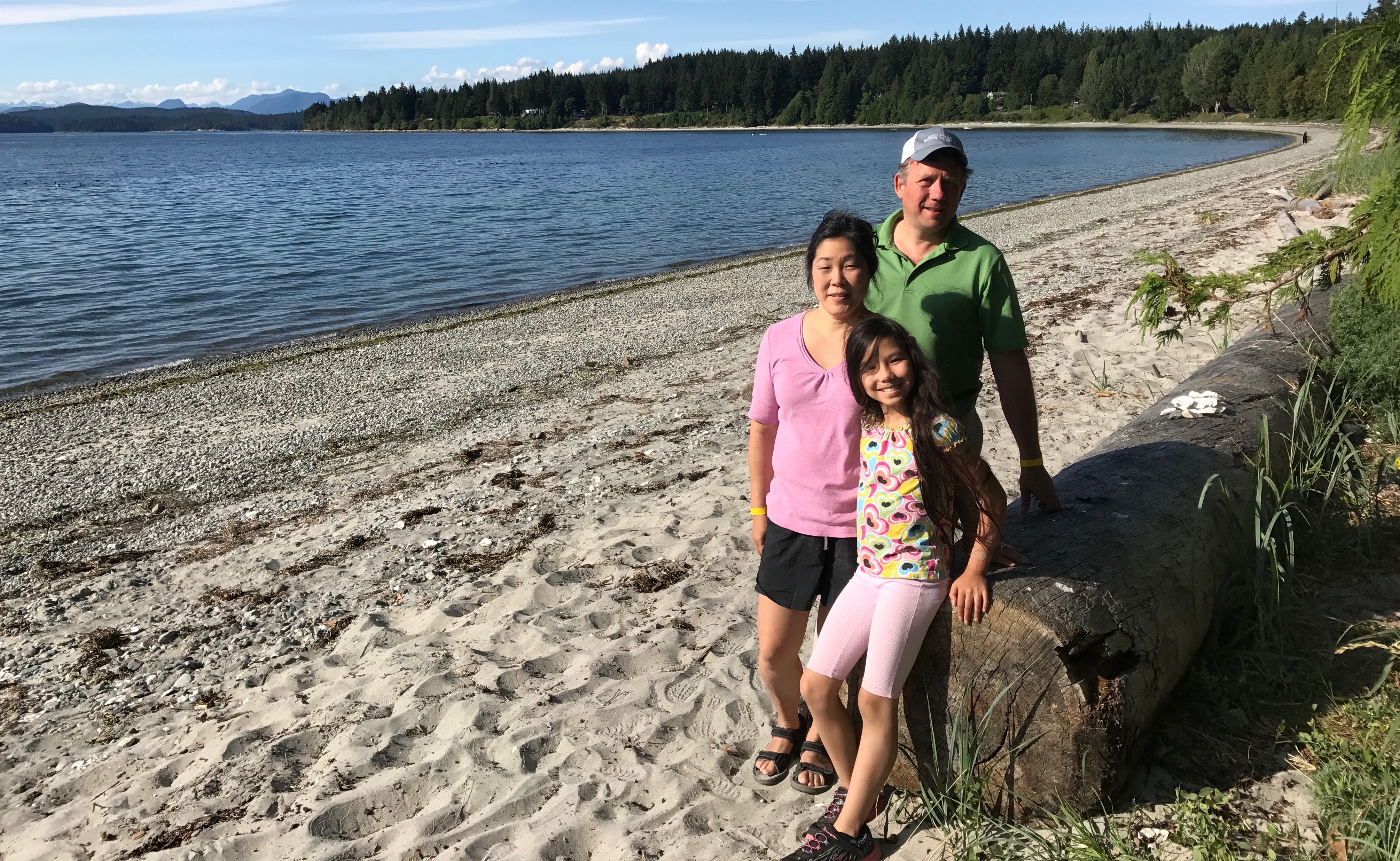
Captain Peter Frost and Kelsey Boesch

So we engaged a young licensed captain from Port Townsend named Peter Frost.  After walking us through the preparations, he met us in Alaska on July 6th along with his partner, Kelsey Boesch.   Here is the account of our voyage on the Outside, a hundred miles off the Alaska and British Columbia coasts.

In struggling find the words to describe this extraordinary voyage, I feel a bit like a space traveler who knows she’s done something few others have had the opportunity to do.   But it should be clear that we loved the trip.   In fact, it promises to alter the course, reorder our priorities and reshape our dreams.

Day 1   Wednesday, July 7, 2010    Seasick!

Coordinates at noon:  56º45′N 135º46′W
We cast off from Sitka at 7 am and motor straight out through a couple of remaining “piles of rocks” until we we’re in the open ocean. A curious sea otter, his breakfast on his stomach, watches us go by.  Looking up, we notice instrument failure number one.   The wind vane at the top of the mast has lost its tail and is bobbing around uselessly.  The damage is recent, certainly done by a large bald eagle, undeterred by the bird proofing mechanism. Seagulls abound in other fishing harbors, but in Sitka there are none to be seen.  Eagles rule the roost, hovering over vessels as they unload, darting after what they can get or just standing watch on masts.
The fog is thick so I volunteer for bow watch, and a shot at real concentration because the queasiness I’d feared is taking hold.  When I start vomiting it’s the best place to be so I just stay up tethered in front and tough it out.
Finally my stomach settles a bit and I head back along the jackline to the cockpit.   On my way, I stoop down to move the jib sheet car back along its track.  With that simple gesture my right thumb joint gets stuck in flexed position.  I can straighten it manually but it doesn’t stay.  As I climb into the cockpit puzzling over this, the other four fingers of my left hand spasm out and become useless.  Within a minute my left calf lumps up with a painful cramp and immediately after that a whole complex of muscles in my right thigh contract violently.  Imagine my confused terror as four limbs fail at once!
Peter calmly reassures me that this is a common symptom of sea sickness.  My body is making a bunch of micro adjustments as it gets used to the motion of the waves and swell.  And he’s dead right.  Within a couple of minutes the  paralyzing cramps and spams subside.  I continue my watch, feeling a strange kind of gratitude that my body knows what it’s doing.  Soon enough my nausea has waned and the physical self confidence I had been so carefully nurturing with daily yoga has returned.

Offshore seascape

The familiar fauna soon yield to albatross, ponderous in size, dark in color, and nearly horizontal in flight.  (According to Wikipedia,”Albatross have high glide ratios, around 22:1 to 23:1, meaning that for every metre they drop, they can travel forward 22 metres.”)  I am tempted to see them as creepy but suppose it’s just a figment of fragment of Coleridge haunting  my imagination.  But then Peter dispels any doubts by recounting an incident during a voyage back from Hawaii, when an albatross flew into the mylar sail of a racing vessel and ripped it in half with its beak!

When we are well off shore – about 40 miles out – we adjust our course toward the south. Aurora’s engine works fine since we have no reason to idle nor reverse and the transmission is regularly nurtured with small doses of fluid.  So we continue to motor through weak and uncertain weather.  Peter has carefully thought out our route so that we’ll be in a position to catch the northwesterlies when they begin.  At noon he pencils in our coordinates on the chart and consults his GPS to verify our course and strategy.   Soon we discover instrument failure number two: the cigarette lighter-style DC power outlet in the companionway does not work.  So we must use AA batteries, of which we have barely enough.  Throughout the trip, Peter will combines his years of experience in navigation with judicious use of his GPS.   Since a compass fix is needed in the open ocean, he determines the course and we stay on it using the compass on the binnacle.
We’re still far north and the days are long.  Toward the end of our 2000 to midnight watch, Jack and I can no longer read the compass.  But we have no idea how to turn on the red night light in the compass, and neither does Peter.  In fact, since we’ve never navigated at night, we had neglected to include the compass when verifying the instrument lights according to the checklist Peter had sent about a week earlier.  With calm aplomb the captain moves us beyond equipment failure number three by duct taping the little red flashlight Jack bought to the permitter of the dome on the binnacle.

Day 2 Thursday, July 8     Routine

Coordinates at noon:  54º46′N 134º55′W
Segmenting this account into days is misleading since we never stop. Every day includes night and the period of darkness lengthens as we cross parallels going southward.
We’re setting into our watch schedule, which combines two daytime watches of six hours each with three evening-night-early ones of only four hours.   Today’s looks like this:
0800-1400   Peter & Kelsey
1400-2000 Jack & Carol
2000-0000 Peter & Kelsey
0000-0400 Jack & Carol
0400-0800 Peter & Kelsey
This rotation is a flip of yesterday’s. In the last 24-hour period Jack and I had 14 hours on duty at the helm; in this one we have only 10 but it includes the midnight to 4 am watch.   The new team comes up from below on ten to fifteen minutes before the previous watch ends to be briefed and get the feel for the point of sail, the height and intervals of the waves, and the (steady or gusty) quality of the winds.
When Jack and I go above for our 4 am watch, Peter and Kelsey brief us on the graveyard shift saying they’d enjoyed the Northern Lights.

Off watch sleeping through a long port tack

Nice as it would be to see everything, it’s more important for us to go below, cook some hot food, and get some sleep.  We are very small beings in the middle of vast seas and our bodies seem to know what they need.  Sleep comes easily;  the best we can be is ready for the next watch as well as anything for which extra hands are required.

Peter has been doing 24-hour watches since he was a child and now as a licensed captain sleeping in snatches while being alert to ship and crew seems to be instinctive.  No only does he come up the companionway to check on us, he uses whatever issue Jack and I are musing about as an opportunity for hands on instruction.
Unlike Steve Plantz, Peter was not one of those kids raised at sea.  Thanks to a fortuitous set of circumstances, however, every summer he was able to step out of an otherwise normal American childhood.  Starting at the age of nine he spent summers crewing on a sailing vessel which plied the Great Lakes 24 hours a day.   Peter credits the Canadian youth program that seems almost a throwback to British naval training in 18th century with providing a solid foundation.  He returned to the brigantine every summer until he was fourteen, when they were shipwrecked.  As only of three of a crew of 33 neither injured nor a victim of seasickness, Peter recounts the details of this unwelcome opportunity to perform under stress.  Jack and I listen in grateful amazement that this seafarer, not yet thirty years old, has nearly twenty years offshore experience.
We are under sail about 100 miles out.  Our southeast course takes us past Prince of Wales Island in the morning and past Dixon Entrance in the afternoon.

Day 3   Friday, July 9     Weather

Coordinates at noon: 53º18′N 134º21′

At reports of worsening weather, we make a detour, motoring several hours to get out its path.  Now southerly winds mix with rain and push us on.  Opposite the Queen Charlotte Strait, the weather turns nasty. Peter and Kelsey take over at the helm and Jack and I go below.

Deck with troublesome swim ladder

Although we’ve cleared the deck of most everything, the preventer – a line  that restrains the boom to prevent an accidental jibe – gets caught on  on the aluminum swim ladder, bending it and forcing Peter to go forward to unhook it.   Now that we’re rid of the old hard shell skiff  that covered the place where the ladder is bolted to the deck we’ll have to do something about it.  At the same time, the absence of skiff has vastly improved visibility.  In fact, now we can sit on port or starboard and maintain our course by lining up numbers on the compass with stationary guides positioned 45º degrees to either side of the desired heading.

Sitting at the helm and using the compass works less well in coastal cruising.  Along a coast you have one eye on the chart, the other usually on the point of land to which you’re headed.  Water depths constantly change thanks to irregular bottoms and the high tides of the North Pacific.  The shape of the land affects the velocity and direction of the winds and accounts for crazy currents and roiling rips.  And you need to pay attention to other boats, and hope they are paying attention to you.  After thinking about it a bit, Jack and I realize that offshore sailing under the tutorage of a skilled instructor and navigator can work for fledgelings learning to sail.
At the same time we’re thankful the skills in coastal navigation we’ve acquired and the different sort of concentration sailing in more sheltered water takes.  We rarely do more than ten or twelve hours at a stretch between anchorages but long days are exhausting and often leave the First Mate pleading for extra hands on deck.  But unless they’ve got specific assignments and really want to be there, having friends on board can be distracting.  So we ponder ways to manage more challenging voyages and the practicality and prudence of well-thought out watches.
Watches also make a small boat feel much bigger. Except for a pre-departure dinner, we have not shared a meal with Peter and Kelsey.  We’re hot berthing, sleeping in the same places close to the mast.  That leaves accessible space for personal effects fore and aft.  Finding things in a hurry is important.  My undocumented stashing of foodstuffs in fridge, lockers and bilge has had us rifling a bit but [almost] never for important things like headlamps, gloves, wrenches, extra line, binoculars, duct tape and the like.

Day 4    Saturday, July 10      Musings

Coordinates at noon: 51º48′N 131º58′W

Brilliant hues of sunrise

The view constantly changing

Jack and I pull daybreak and afternoon watches.  The gleam of morning sneaks over the horizon covering the enormous swells with a skim of crinkled, pink foil.  Minutes later the sea is billows golden chiffon.   The hues are so vivid that we are tempted to wake up Peter and Kelsey but we regale them with stories and photos when they come on watch.  After all we missed the aurora borealis; in 24/7 passage making you just can’t experience everything happening around you, although this comes pretty close.

Our six-hour afternoon watch follows a long satisfying nap and a good meal.  Winds are from the northwest, seas are high, sun is full.  In sweater sleeves – it’s warm –  Jack and I alternate 30 minutes at the helm.  We’re headed southeast – 135º magnetic – with ten knot winds moving Aurora along at five and a half knots.  The lightness of the winds make it all the more difficult to keep the compass needle between 130ºM and 140ºM.

Captain Peter emerges briefly from the companion way to demonstrate the micro movements the helmsman must master.  I keep my hands steady on the wheel, note the approximate orb and make it part of my rhythm. There no need to twirl the wheel or make big adjustments, if one stays attentive.  And without headlands, mountains or stars to head for, all my focus is on the compass in front of me.

The sky is cloudless and the line of the horizon distinct.  From where we are sitting in the cockpit, the horizon is a mere three and a half miles away.  This is our own tiny patch of the Pacific.  No wonder we’ve seen no other boats since that troller in the fog less than an hour out of Sitka.

Getting the hand of the helm

The nearness of the horizon inspires reverence and respect.  Our planet is small: it drops off quickly.  When we gaze out on successive ranges of mountains, as you might do heading inland from the Oregon Coast, or looking  northwest from Islamabad or Boulder, the world seems much bigger than it really is.  The seas don’t lie.  If we stand up on the spinnaker box on the deck against the mast, we might see a seven or eight miles radius to the horizon, from the top of the mast perhaps 25.  A very compact area.  Almost cozy.  Nothing like I’d imagined.   No wonder the ancient mariners knew the earth was a sphere, something it took centuries for their land-lubbing cousins to grasp.

I get better at keeping the yellow needle of the compass on target.  I watch intensely as the black disk, all 360 degrees calibrated in white, bibs and spins in its ocean of oil under the glass dome of the compass.  The compass is about 7 inches across, the radius to its horizon three-and-a-half inches, which echos the three-and-a-half miles of ours.  Our great dome of the sky is now evenly light grey, like milky glass, the slate purple grey of the sea gently rocking and bobbing Aurora exactly in its center.  I imagine a miniature sailing ship in a glass bottle, although this time it is a tiny Aurora floating at the center of the compass enclosed in the hemispherical glass dome atop the binnacle.

Day 5    Sunday, July 11    Encounters!

Coordinates at noon: 49º55′N 130º00′W
At about 50º10′N 130º30′W, when I am at the helm facing heavy seas, something smacks low against the keel.  ”Look at that sunfish!” Peter exclaims  I manage to stay focussed and not turn around but Jack says it looks something like a huge barn door.  ”A barn door that must really hurt.” [ Wikipedia on sunfish: "unique fish whose bodies come to an end just behind the dorsal and anal fins, giving them a "half-a-fish" appearance….the largest of the ray-finned bony fishes, recorded at up to 3.3 metres in length and 2 tonnes in weight.]

When the wind kicks up, we reef the main.

The winds are stiffening now, but I am getting the hang of the helm.  The helm is usually Jack’s task so this is great experience for me.  To keep the ship on our heading of 135º magnetic, I need to keep that compass needle somewhere between 1-3-0 and 1-4-0 on the dial.  Despite the good wind, the seas are rolling us a bit.  My attention needs to be sharp and complete but  my shoulders and hands relaxed as I turn the wheel.  Toward the end of my watch, I enter yogic space between ease and effort and feel my practice is finally bringing results.

Then suddenly, the boom whirls across the cockpit in an accidental jibe.  Worse, the force pulls the preventer, a block and line designed to prevent the wind from getting on the wrong side of the sail, right out of the boom.  I am devastated.
Peter rushes up to deck and gets Aurora back on the proper heading.   With a spare line about sixty feet in length we rig a makeshift preventer, tying one end to the boom and the other to a cleat in the bow, dipping and rising between great following waves.  When Peter finishes, he asks me gently if I’m “ready to get back on the horse.”  It’s noon, so I take the helm briefly while he goes below to check our position and progress of the past 24 hours and pencil them on the chart.  When he emerges from the companionway, he says with a broad smile, “You’ll be interested to know that we’ve just crossed an area of magnetic disturbance.”  Ah, ha!   It was the compass that got mixed up!

Jack takes helm as swells rise behind him

For four days we’ve had our bit of ocean to ourselves, but on the evening watch Jack and I spot a southbound ship on the horizon and then another and another.  Their massiveness is half hidden by the horizon and the huge swells make them disappear all together.  At a distance of a couple of miles they are as benign as the three ships of the Christmas Carol sailing toward [landlocked] Bethlehem.   But we know we are near an open ocean shipping lane and we intersperse visual checks of the horizon every five minutes with checks of the radar, which is bouncing with all the noise the waves are throwing up.

At midnight Kesley and Peter take over at the helm and shortly afterwards (49º30′N 128º20′W) Kelsey calls me back on deck.  There’s a ship bearing at 2 o’clock and the disposition of its lights suggests it’s headed toward us and they are not responding to radio calls.  Peter has turned into the wind in an attempt to speed past it, moving from his 090 heading to 060.  Kelsey and I each take one of the high powered emergency lamps we’re carrying.  I flood the sails with strong light while she flashes her light at the ship.
But the distance is closing and soon we see red and green: when both the port and starboard navigation lights are visible it indicates a collision course. I take the VHF and just keep hailing “the northbound freighter off the west coast of Vancouver Island”.   No response, nothing, silence.   Then miraculously, a weighty, Slavic accented voice responds.  It’s a miracle.  The Zim Djibouti asks our heading.  ”Okay,” says the captain, “I’m changing my heading.”  Slowly the red light disappears and the white masthead lights creep apart to tell us we have their starboard safely abreast of ours.  To come that close in such a huge ocean!   The guy on the Zim Djibouti is clearly surprised but as relieved as we are.   He is very nice.  Explains that he couldn’t see us on his radar.  Advises us to get a new reflector but our radar reflector is a good one and designed for offshore. It’s interesting how nearly everyone seems to have suggestions on stuff you can buy for your boat, even the captain of a passing freighter.  [Later I check the Internet and learn that M/V Zim Djibouti is "one of the largest container ships operating in the world" and travels at 25.8 knots. And btw our radar detector is top of the line. Swells just too big. ]
As the night lengthens, my gratitude for the escape from danger multiplies and Nature co-conspires to regale us with a sublimely glorious encounter.  Aurora’s wake is now a broad phosphorescent path behind the stern and the waves breaking around the cockpit are full of light.   It’s the phenomenon of bio-luminesence, tiny marine organisms that emit light when surrounding waters are disturbed.  It’s the sprinkles of sparkles seen when paddling at night, or in the splashes of a bucket drawn from the sea, or whirling around in the bowl of the head when it is flushed.  But tonight we have a full-blown show.  All around us – even at some distance – are light-capped waves.  Billions and billions of creatures are performing for us!   And then suddenly there are ribbons of light streaming alongside the boat, forward and aft, port and starboard. Dolphins! They dart to and fro, playing in our bow waves, enjoying their strength.  In the tubes of light in which they swim we see their large white spots.  Like firework-spouting tug boats escorting a great ocean liner into port, a pod of Pacific-white sided dolphins are our escort through this patch of wilderness night.
Beyond the continental shelf along Vancouver Island, the ocean floor slopes down to minue 10,000 feet or more to what is known as the Abbysmal Plain.  But from these depths rise seamounts, knolls and ridges, giant underwater mountains.  A few rise to just 1500 to 2000 feet below sea level, bringing rich habitat and dolphin feeding grounds just beneath our keel.  This time the short intense blackness of our night has coincided with a wondrous display.

Day 6     Monday, July 12    Speed

Coordinates at noon: 48º52′N 126º30′

Peter keeps us on course in heavy seas

The adrenaline is flowing, keeping Peter’s judgement sharp and energy  unflagging. He’s been at the helm most of the day and is totally in his element.  He and Kelsey have double tethered and opted to stay on deck through our watch.  Jack and I hand up Clif bars and exchange words from the companionway.

It’s too rough for Jack to go up to the cockpit; we both struggle to move around safely below as it is.  Whereas we’ve been been using one salon berth and the floor below it – port or starboard as appropriate – now we are both bedded down on the sole. Were the boat to get tossed Jack would too and land on top of me.  We feel the speed through the length of our spines as Aurora creaks and groans.
Peter has been sailing the Gulf of Alaska for years. In fact, this his second trip this summer, the first taking him from Seward to Juneau following a coastal cruise down the Inside Passage.  Back when he started college in Olympia, he bought an old 27-foot Oday to have a place to live.  Soon enough he had it fixed up and seems to sailed up the coast at every possible opportunity.  So when the Environment Canada announces 25 to 35 knot winds he knows that not only is that fine, it’s also probably an exaggeration.  Indeed, Jack and I have rarely experienced winds as strong as official Canadian predictions.

Kelsey in a trough between huge swells

But today the winds are forty knots and gusting well above that. We thought that the Brooks Peninsula, which sticks out from the top of the northwest coast of Vancouver Island, might break up the swells a bit, but it is not to be.  Kelsey has put the drop boards in the companionway hatch but occasionally will take the top one off and shout down “Fourteen and a half knots!”   Anybody who knows anything about hull speed knows a forty foot boat can’t move this fast.  But under these extraordinary conditions of high winds, broadly spaced swells and following seas, Aurora is surfing, riding half out the water, surfing.

A blend of intense concentration, physical strength, quiet confidence and sheer joy can be seen on Peter’s face every time we look up the companionway.  He’s been at the helm fourteen hours straight and is going strong.  There is nothing quite as efficient as forty feet of Valiant with Carol Hasse sails and free air.
The distant shore of Vancouver Island finally begins to recede as we round the southern tip.  Once we have been soundly shaken by the confused winds and currents of the approach to the West Entrance of the Strait of Juan de Fuca, we got up on deck in the waning sun. This is our first time here but years of marine weather reports have established its reputation for being pretty terrible most of the time.
Dusk brings weariness. Justifiable for Peter and Kelsey, it becomes contagious.  The shore of Washington state is in the distance: in a way we have arrived.  As we cross the great shipping lanes of the Strait, we need to inform radio vessel traffic service  that we’ve entered the strait.  We hail “Seattle traffic” on channel 5A but get no response; maybe our VHF defaults to channel 5.  We then try  VTS for south of Seattle on channel 14, but they fail to respond.  We’re down to our last set of fresh AA batteries for the GPS unit, though we can recycle the old ones and ones stolen from ordinary radios and flashlights.  Remaining on the lookout in all directions, we cross the lane for the local westbound traffic, then the one for ships bound for the  Pacific, then the mile-wide separation lane, and the eastbound, for vessels headed to Vancouver and Seattle, finally landing in the lane for local eastbound boats.  Jack is consulting the Navionics charts on his iPhone, but the information he’s getting doesn’t gel with what Peter’s has.  As black night closes tightly in, a ship passes in a place it clearly  shouldn’t be.  The currents are troubled and although I’ll confess it to no one, I suddenly feel my first discouragement all trip.
Peter reviews our options.  We are opposite the reservation of the Makah Nation at the tip of the Olympic Peninsula, where the lights of Neah Bay twinkle seductively.  The promise of sleep brings the alertness we need to guide our ship and anchor in its tiny harbor.

Day  7      Monday, July 13    Stars

Coordinates at noon:  48º21′N 124º36′W
The sun streaming through the plexiglas of the aft cabin hatch finally wakes me from long uninterrupted sleep.  The others are up.  Kelsey and Peter smile broadly, as if on a drug-induced high, but thoroughly revived after going without sleep for more than twenty-four hours.   Peter pencils the noon coordinates on the paper chart and discovers that we have covered 150 miles a day for three days in row.  This is unheard of.  Who gets back from Alaska that fast?  Peter recounts how at one moment clocked a speed of 17.5 knots, the fastest he’s ever gone in any sailboat.   It happened when a gust of 60 or 70 knots shoved a cresting swell from behind causing Aurora to soar and surf.  On either side, walls of water shot past, enclosing the cockpit.
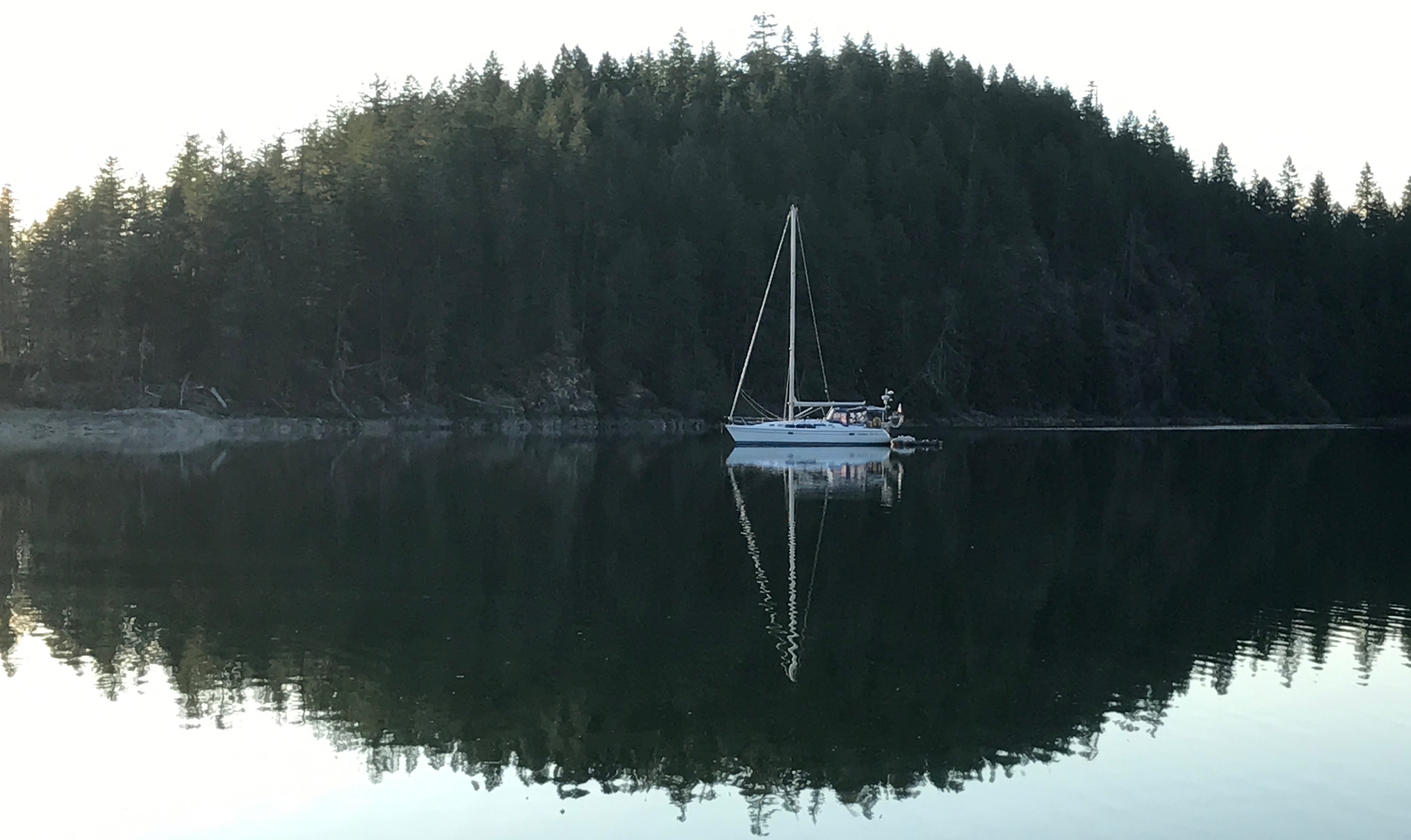
Setting sun on Juan de Fuca floods cockpit

At last able to cook and safely cut up our remaining fresh fruit, we sit down to a huge breakfast.  Some of us check voicemail and messages, others are just not ready.  After a singular grasse matinee we lift anchor, tie up at the village dock,  top off with fresh water and head to shore for AA batteries.  Neah Bay is by no means affluent, but the waterfront seems forward looking with finishing touches being put on a new casino.  Interestingly, Neah Bay is a dry town, like British Columbia’s Hartley Bay.  Unlike the latter, however, there are stores.   The big hardware store sports a bulletin board with up to date notices.  Out front a girl at a card table is signing up people for an event.  When pay for our batteries, we admire Makah baskets, drums and shell jewelry newly crafted by Neah Bay residents.

It’s already early afternoon when we head back out into the Strait.   It’s blowing with gentle steadiness from the West.  Soon our broad reach turns into wing and wing and eventually we pole out the jib on starboard.  It’s a beautiful day, but there are hardly any other boats.  We stay a mile or two off the Washington shore, passing Clallam Bay, Crescent Bay and Freshwater Bay, relishing the growing heights of the snowy Olympic peaks.  Warm sun floods the cockpit.  We thaw out a huge hunk of the king that Mike gave us back early June and feast on salmon, vegetables and rice and the dregs of plastic bag of Franzia merlot we find hiding behind the water bottles.
The mainsail on one side and the genoa on the other signal our forward progress as the fiery orb sinks behind a luminous horizon.
Then the stars appear, more and more and more of them.   They come right down to the blackness of the land, to the jagged line where the Olympics fall to the sea.  The firmament is a star-speckled blanket with a great cream stripe of Milky Way in the middle.  We are still wing and wing with Peter at the helm.   Unwilling to miss any part of it, he recommends three hour watches.  I get to stay on deck while Jack and Kelsey go below.

Running wing and wing under the stars

The glow of lights that is Port Angeles passes on starboard and on port those of Victoria in the distance, on the more familiar shore.  A westbound ship briefly breaks through the darkness and the silence and is gone.  There is nobody else around. The Milky Way arches above us, framing the sails perfectly parallel to our beam.   Engulfed in the theatrical resplendence of it all.

Suddenly Peter asks me to go below and bring up the high powered lamps.  He has eyes in the back of his head and has seen or heard something I missed.  Indeed, when I return I notice the green and red lights of a ship headed toward our port side aft.   I throw a bright beam on our sails while he aims the second straight on the approaching vessel.  Soon enough they hail us on the radio.  It’s the Coast Guard and it’s their practice to board recreational boats, which after some discussion on their end, they decide they will do “as soon as we can get a boarding party together.”  They ask if we have any arms; we reply no.
For the next two hours the peaceful silence of our run under sail is broken first by the Coast Guard cutter out of Port Angeles, which follows us throughout, and eventually by a noisy inflatable that draws up alongside.  Weird as it is to have armed men enter your home in the middle of the night, we are ready.   Back in Sitka, Jack has checked all the safety equipment according the checklist provided by Pacific NW Expeditions and Aurora’s documents are all in a plastic envelop in the nav station.  Since my name’s on them as co-owner, I can handle it; Jack opts to stay holed up in our diminutive “aft cabin”.
Neither boarding a boat under sail nor being boarded is easy, much less in the black of night. But Peter’s cool at the helm and we figure we’re providing an excellent training opportunity to young Coast Guard recruits.  The first man to stumble on says he needs to check to see if it’s safe for others in the boarding party.  He goes down the companionway and checks all the bilges before giving the all clear.  The inflatable pulls alongside again and dumps out two more guys.  They are polite as they go through the checklist:   Everybody’s got life jackets.  Fire extinguishers recently checked and tagged. Emergency flares up to date.  VHF works. “No Oil Dumping” decal posted (fortunately they have no authority to cite us for a dirty bilge). Navigation rulebook on the shelf.  Correct illumination of navigation lights (this catches them up since few ever board boats under sail at night.) Documentation in order.  The team leader sits in the cockpit, working on a little backlit PDA.  I wonder why I need to sign on the screen before he prints out the little receipt but when I do everything checks out.  He assures me that the receipt should protect us from routine boardings for three years.   But, gee, two hours time with twenty men burning fuel idly in a 72-foot cutter and an 18-foot tender.  Doesn’t the Coast Guard have more important things to do?  Couldn’t we do this at dock? Just like we take our cars to garages for DEQ emissions checks?
We are still running gently wing and wing when Kelsey comes on watch to enjoy the quiet stars before the dawn dims them.

Day 8    Tuesday,  July 14  Home

Coordinates: 48º6′N 122º46′W

Triple-masted schooner rounds Point Wilson

I have just fallen into my deepest dreamiest sleep, when Kelsey wakes me.    Deep fog has closed in, the currents are rushing together confused, and we’re nearing the point where the traffic lanes from Vancouver, Seattle, Bellingham and the Far East converge.  It’s time to unhook the whisker pole that holds out the genoa and take down the sails.  The fog shoves the horizon in near the boat.  With the engine now, we won’t hear the behemoths that ply these waters so attention to both radar and our circle of horizon is all important.  Even though we can see nothing, this is familiar territory.    Juan de Fuca filled with fog and the crazy currents you endure rounding Point Wilson are the price you pay to get to Port Townsend.  And today we are facing the height of the ebb with Puget Sound and Rosario Strait rushing into one another as they empty into the Pacific.  Getting home seems to take forever.

But there is a silver lining in our slow, at times non existent progress against the current.  Shortly after we have heard the last blow of Point Wilson’s fog horn, the sun breaks and its lovely red and white lighthouse comes into view.  As we round the headland, we see the first of more than a hundred Native canoes.  The annual canoe journey of the coastal tribes has come to Port Townsend this year!   In two months in Alaska we saw Tlingit canoes every day: the ceremonial canoes of Hoonah are kept in front of the school, under a wooden canopy guarded by great totems, while Sitka’s great painted canoe is displayed on the waterfront park next to the library.  But this is the first time we see one underway.

Paddlers head to campsite on Port Townsend beach

Native canoe with Mt.Baker in the background

The canoes are long and short, with anywhere from six to twenty paddlers.  Some are dressed in full regalia, others are bare chested.  Some paddle confidently, others are flagging.  There are vessels with high, elegantly carved bows.  Others are covered with the distinctive stylized designs in the traditional red, turquoise, black and white.  Many sport large flags.  We watch the first canoes beach just west of the Marine Science Center and their tired crews disembark.  As we round Point Hudson we see the long line of canoes emerging from Puget Sound.   We later learn that this year’s Celebration will take the paddlers, and their accomplices in power boats laden with supplies, all the way to Neah Bay as it is the Makah Nation that is hosting the crowning event.  Having just come from there, we have an idea of what they will be up against, and applaud their determination.

As wonderful as is Sitka, there is no town more beautiful and welcoming to mariners than Port Townsend.  Still, when we tie up at the dock, I feel that familiar pang of regret.  This voyage is over.

Next Page »


Follow

Get every new post delivered to your Inbox.